
Viking Penannular Spiral Fibula
Specifications
| Color | Bronze |
| Material | Alloy, bronze, antique pewter or copper finish |

- For: men & women (adults)
- Alloy, open ring with a sliding pin, three finishes
- Free shipping from 49€ · secure payment
One Ring, One Pin, Nothing More
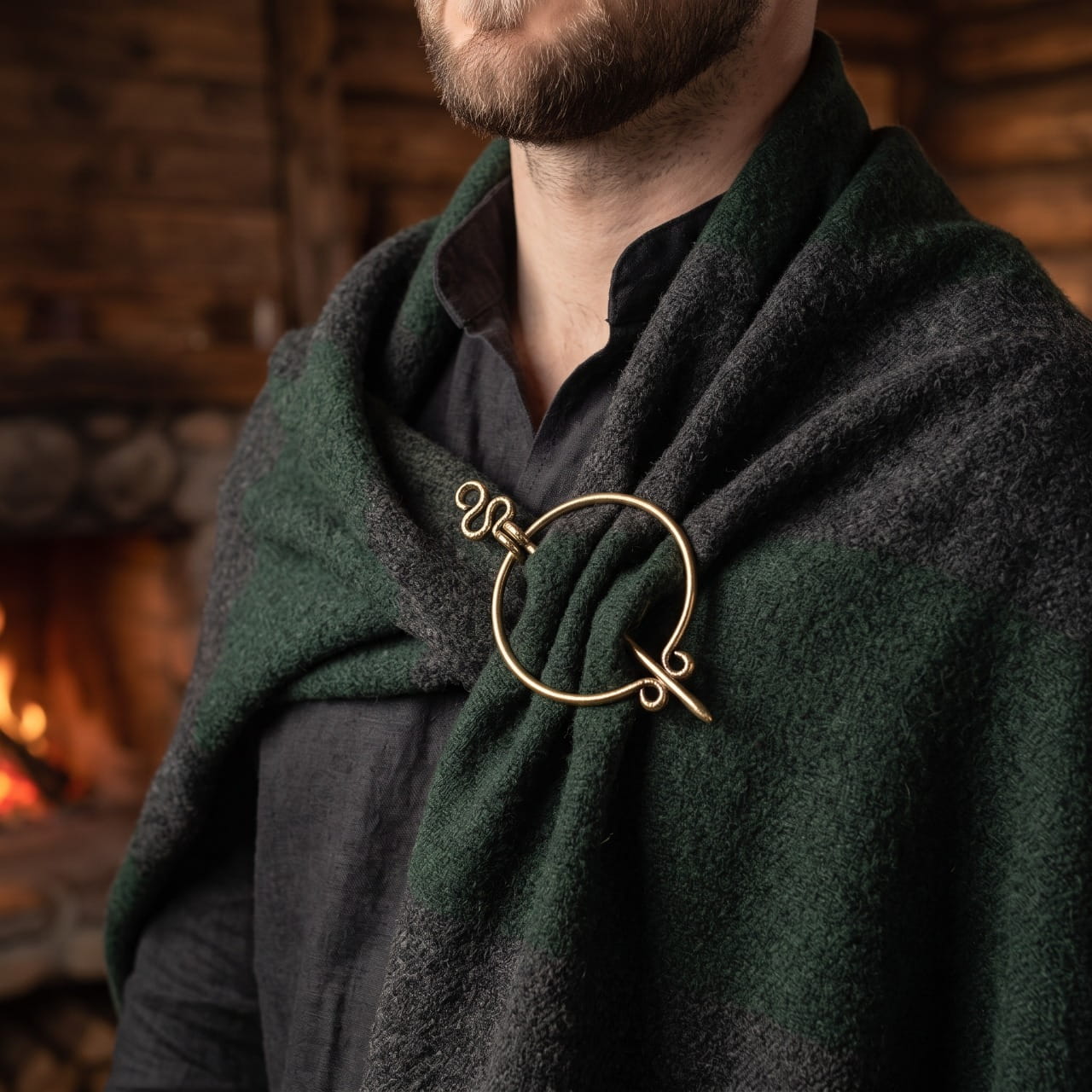
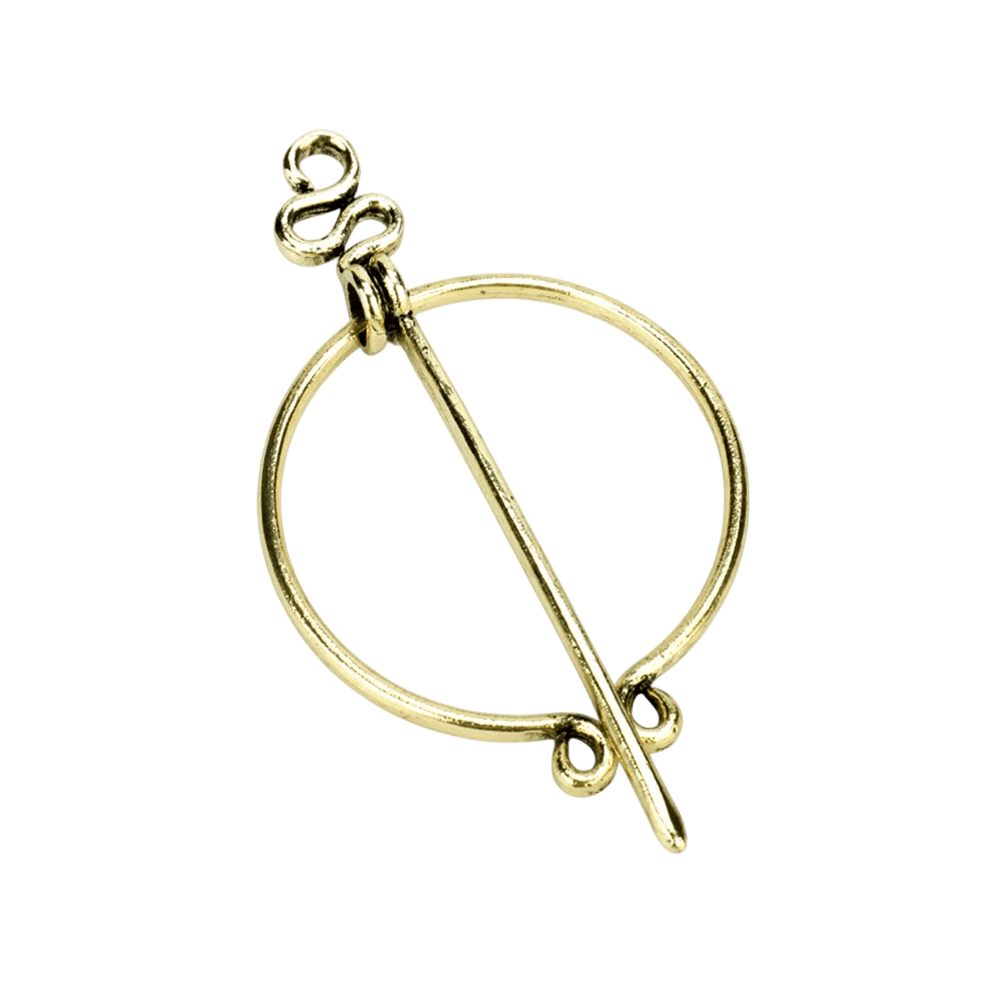
This penannular Viking brooch is reduced to the essentials: a smooth, open ring with two ends curled into small spirals, and a long pin that pivots freely around it. No engraved decoration, no plates. Three finishes to choose from. Find it in our collection of Viking brooches and pins.
For the same fastening with granulated decoration, see the Irish penannular brooch.
What Sets This Brooch Apart
It is the most functional piece in the department, and the only one in three shades.
- No decoration: no interlace, no beasts. The form is the subject.
- Spiral terminals: the end of the wire is simply coiled back on itself — the oldest solution for finishing a ring without a sharp point.
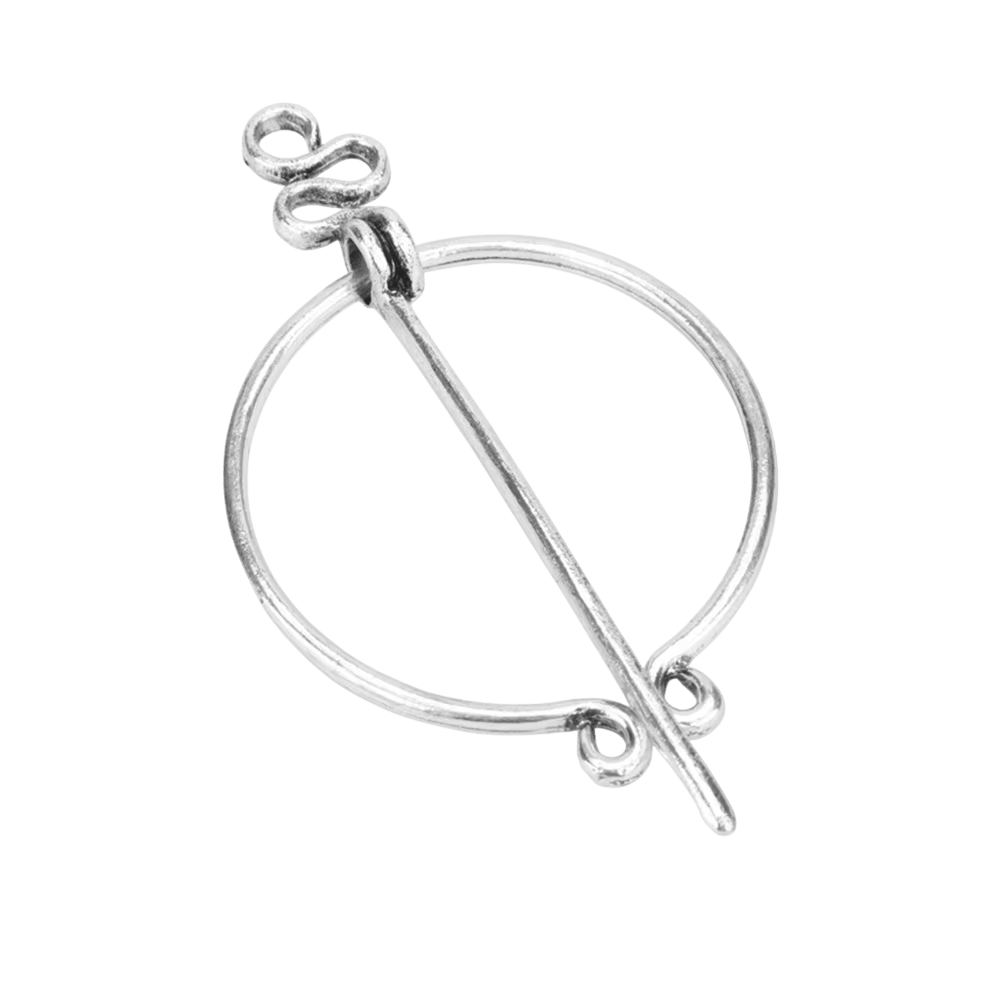
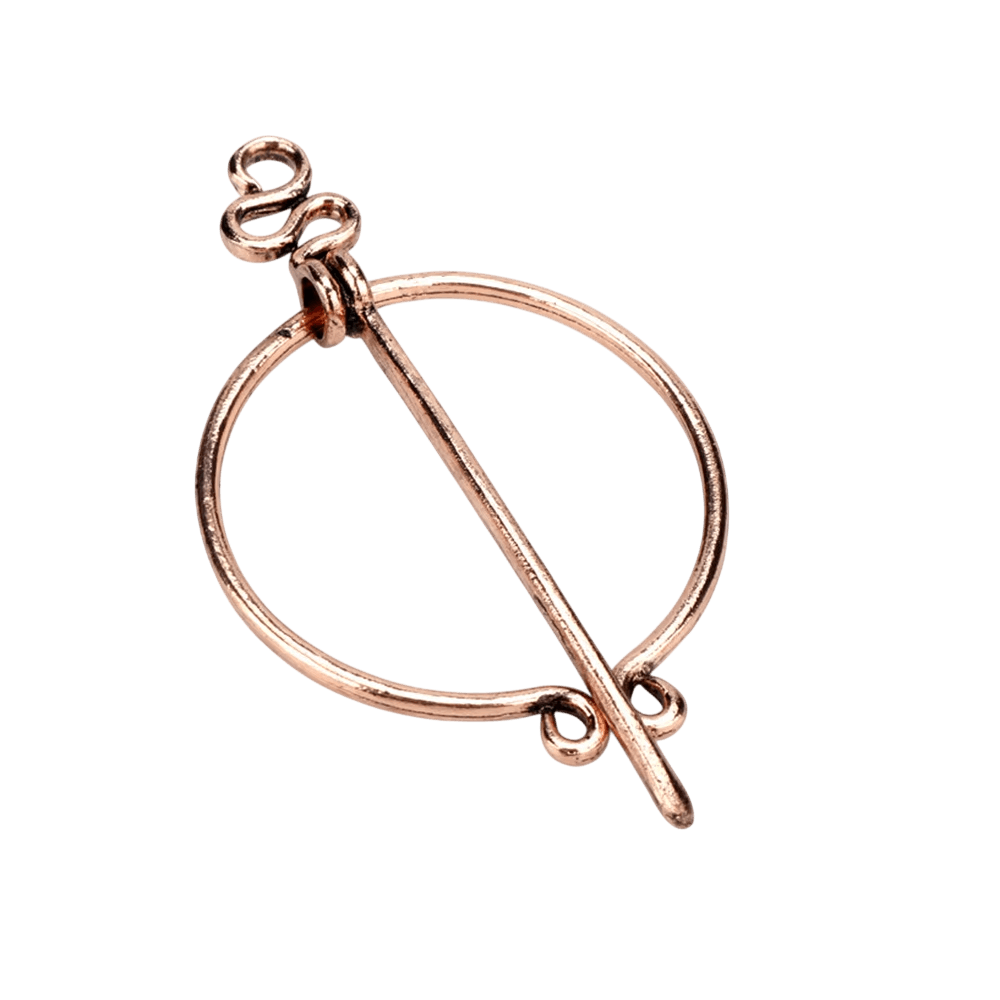
- Three finishes: bronze, antique tin, or copper.
- Nothing to break: no hinge, no spring, no clasp.
If your fabric is too thin for this setup, the escutcheon brooch fastens with a pin and clasp.
Specifications
- Material: Alloy, bronze, antique tin, or copper finish
- Shape: Smooth penannular ring, spiral terminals
- Fastening: Movable pin, held by the tension of the fabric
- Worn on: Cape, shawl, thick wool coat
- Care: Dry cloth, avoid water and perfume
Did you know?
The penannular brooch is one of the rare objects that spans all of European history without changing its principle. It is found among the Iron Age Celts, the Romans in Britain, the Irish of the 8th century, the Scandinavians of the 10th — and it still works the same way today. The most famous, the Tara Brooch, discovered in 1850 on an Irish beach and dated to around 700, features over seventy different motifs on less than nine centimeters in diameter, including filigree, granulation, and cast glass. It has no actual connection to the Hill of Tara: the merchant who sold it invented the name to sell it for a higher price.
📖 To learn more: Discover our article on the Vikings who settled in the West.
♦ Complete Your Viking Collection
Discover other pieces you might like:
Brooch or hair barrette: which one to choose?
| Type | Where it is worn | What you need to know |
|---|---|---|
| Garment brooch (fibula) this product | On a cloak, a shawl, a coat or a jacket lapel. | These are the largest pieces in the range. Six close with a straight pin and a clasp; two are penannular: an open ring locked by the tension of the fabric, with no spring to wear out. |
| Barrette with a hair stick | In a bun, a braid or a half-up ponytail. | Two pieces: the plate sits on the hair, the stick goes through the lock and holds everything in place. You need enough hair for the stick to go through: with hair shorter than shoulder length, the hold becomes uncertain. |
| Light barrette or clip | On medium-length hair, including fine hair. | The filigree models have a small chain that holds the stick; the flat barrettes close with a clip and need no minimum length. These are the most discreet pieces and the easiest to put in. |
| Medallion barrette | Flat on a half-up ponytail or a low bun. | A solid disc that sits on the gathered lock instead of going through it. It is the shape that needs the least hair length, and the only one that shows a scene rather than an ornament. |
How to wear it
There is no size to choose. A brooch (fibula) is fastened to the fabric, not to the body: the only question is the cloth.
The six straight-pin models are worn like a classic brooch: push the pin through the fabric and close the clasp. They suit a jacket lapel, a shawl or a thick scarf.
The two penannular models (the open ring crossed by a long pin) work differently: pass the pin through the cloth, turn it a quarter turn, and the tension of the garment locks it against the ring. The more the cloak pulls, the tighter it holds. It is the most secure fastening on heavy wool, and the one with no mechanical part to break.
On thin fabric, any pin leaves a mark. These pieces are made for broadcloth, wool and thick linen, not for silk or fine knits.
Care: dry cloth. Avoid water, perfume and silver polish, which remove the patina lodged in the hollows: it is what gives the design all its relief.
How do you fasten a penannular brooch?
In three moves. Pinch the fabric, push the pin through it and bring it out through the gap in the ring, then turn the ring a quarter turn: the pin ends up locked behind it. It's the tension of the fabric that holds it closed, not a mechanism.
Does it hold on thin fabric?
No, not well. This design needs material to grip: thick wool, a cloak, a woven shawl. On a shirt or a fine knit, it will slip. Our brooches with a pin and clasp are better suited to those fabrics.
Which finish should I choose?
Bronze is the warmest, copper redder and brighter, aged pewter the most neutral and the closest to an old gray. All three have the same ring and the same pin.
Can the pin get lost?
No, it's wrapped around the ring and pivots freely without being able to come off. There are no removable parts.
Delivery — Allow 7 to 15 business days for mainland France, 10 to 20 days for the European Union. Free delivery on orders over €49.
Delivery guarantee — If your parcel is not delivered within 60 business days, we will provide an immediate reshipment or a full refund.
14-day returns — You have 14 calendar days from receipt to request an exchange or refund. The item must be returned within this period, in its original packaging.
Legal guarantees — All our products are covered by the legal guarantee of conformity and the guarantee against hidden defects, in accordance with the Consumer Code and the Civil Code.


