

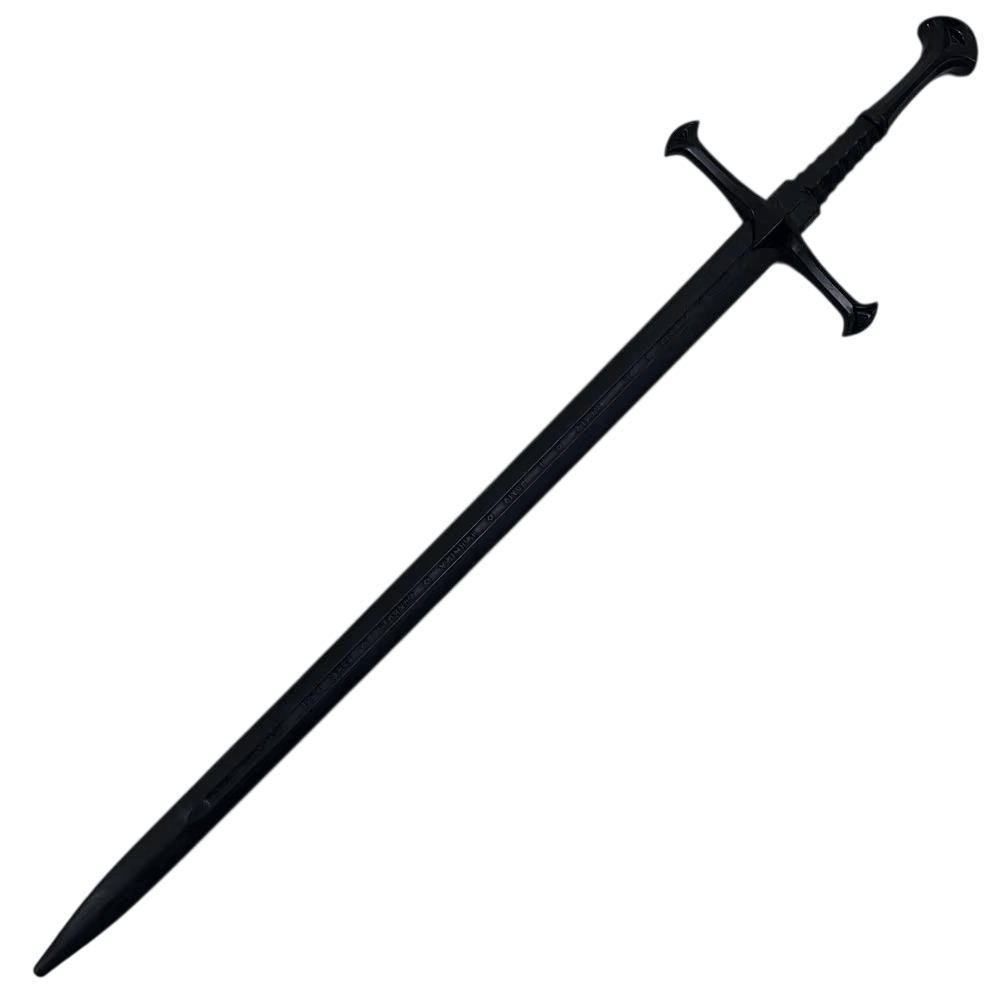
Polypropylene Training Longsword: Black, 95 cm
Specifications
| Color | Black |
| Material | Black polypropylene, molded in one piece |
| Dimensions | About 95 cm long, 22 cm grip |



- For: men and women (adults)
- Black polypropylene, molded in one piece
- About 95 cm long, 22 cm grip
- Practice tool: no edge, no point
- Free shipping from 49€ · secure payment
This is not a costume replica — it is a practice tool
A polypropylene longsword molded in a single piece: the blade, crossguard, and handle all come from the same block, with no assembly to loosen. The guard descends in two quillons curved toward the blade, and the pommel is open in a ring shape. Ninety-five centimeters for a two-handed grip.
Find this piece in our weapons department.
What sets this piece apart
- Polypropylene is the material of historical fencing. It withstands repeated contact without splitting, where wood would shatter and foam would crush. It is what we put in the hands of a beginner in the training hall.
- Molded as one piece: no tang, no rivets, no assembly. This is precisely what decorative replicas lack, as their blades eventually become loose in the handle.
- Neither sharp nor pointed: the edges are rounded and the tip is thickened. It remains a simulator, to be used with the standard protective gear.
- It is a practice tool, not a prop: neither sharp nor pointed, but designed to withstand repeated contact. It should be handled with protective equipment and a notified partner.
Specifications
- Material: One-piece molded black polypropylene
- Dimensions: Approximately 95 cm long, 22 cm handle
- Usage: training, historical fencing, reenactment
- Sold: individually
Did you know?
The idea of a training simulator is nothing new. The Romans had their recruits train with the rudis, a wooden sword deliberately heavier than the actual weapon, against a post planted in the ground. Vegetius explains why: "soldiers thus learned to strike with the point rather than the edge," and the real weapon felt light at the moment of combat. Medieval fencing treatises adopted the principle with wooden swords and later blunted steel. Polypropylene is merely the contemporary version of a practice that is two thousand years old.
To learn more, our anatomy of the Viking sword explains the purpose of every part of an ancient blade, and our feature on the Ulfberht sword tells the story of the steel that made these blades famous.
In the same category
Is this sword a toy?
No. It is a polypropylene training simulator, the material used in historical fencing. It is neither sharp-edged nor pointed, but it hits hard: the usual protective gear is still necessary.
How is it different from a foam replica?
Foam absorbs impact and compresses; it is made for costume use. Polypropylene is rigid and withstands repeated contact: it transmits the impact and lets you practice techniques.
Can I use it for LARP?
It depends on the event's rules: many LARP events ban polypropylene and only allow foam. Check before you go.
Is it assembled or molded?
Molded in one piece. There is no tang, rivet or glued joint that could work loose with use.
Delivery — Allow 7 to 15 business days for mainland France, 10 to 20 days for the European Union. Free delivery on orders over €49.
Delivery guarantee — If your parcel is not delivered within 60 business days, we will provide an immediate reshipment or a full refund.
14-day returns — You have 14 calendar days from receipt to request an exchange or refund. The item must be returned within this period, in its original packaging.
Legal guarantees — All our products are covered by the legal guarantee of conformity and the guarantee against hidden defects, in accordance with the Consumer Code and the Civil Code.


