
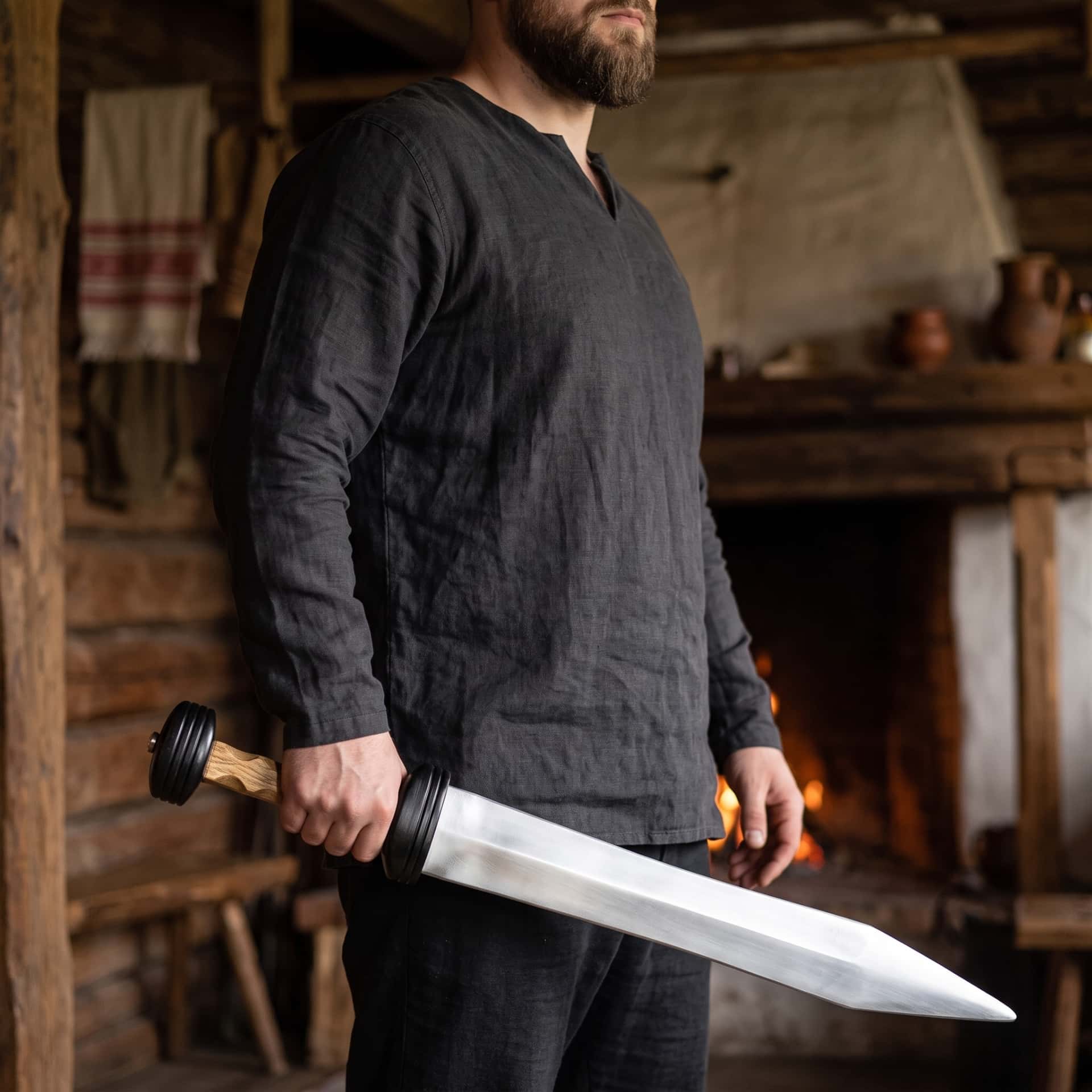
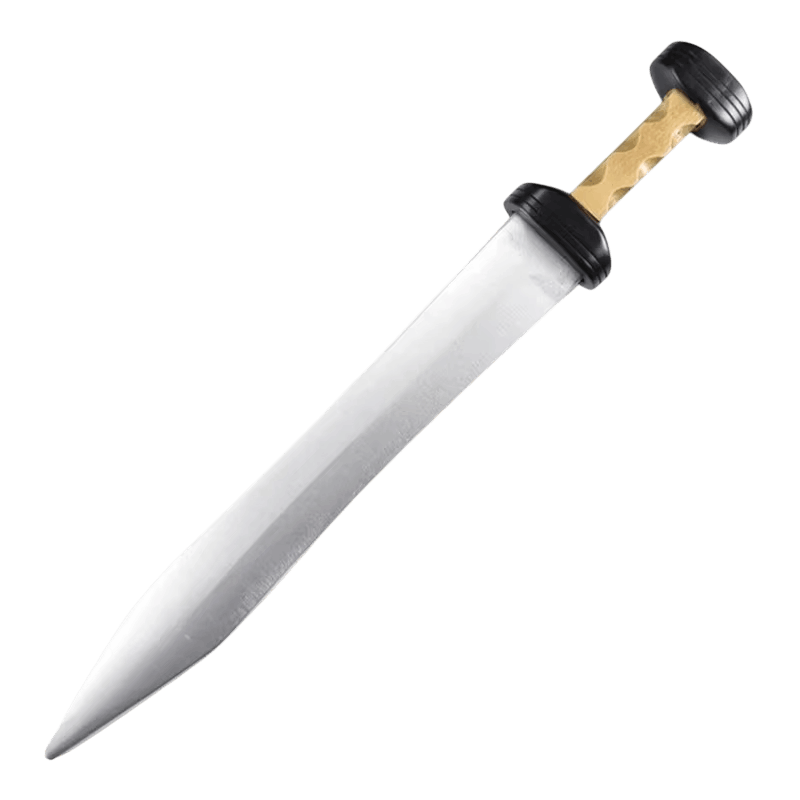
Roman Training Gladius: Bright Blade, 70 cm
Specifications
| Color | Black, Brown |
| Material | Solid hardwood, light lacquered blade, black guard and pommel |
| Dimensions | About 70 cm long, 50 cm blade |


- For: men and women (adults)
- Solid hardwood, light lacquered blade, black guard and pommel
- About 70 cm long, 50 cm blade
- Practice tool: no edge, no point
- Free shipping from 49€ · secure payment
The same gladius, dressed up for the camera
The same piece of solid wood as our raw gladius, but dressed up: the blade is lacquered in a silver-white that mimics polished steel, the guard and pommel are black, and the grip remains in light wood. From two meters away, you cannot tell it's wood.
Find this piece in our weapons section.
What sets this piece apart
- Contrast does all the work: light blade, black guard and pommel, wooden grip. This is the version that photographs well and shows up on stage.
- The same sturdiness: beneath the lacquer, it is the same single-piece block of hardwood as the raw model. Nothing is glued or assembled.
- Lacquer marks: this is the honest trade-off. With repeated contact, the white flakes off on the edges where raw wood would simply develop a patina.
- It is a practice tool, not an accessory: neither sharp nor pointed, but designed to withstand repeated contact. It should be handled with protective gear and a partner who is aware.
Specifications
- Material: Solid hardwood, light lacquered blade, black guard and pommel
- Dimensions: Approximately 70 cm long, 50 cm blade
- Use: training, historical fencing, reenactment
- Sold: individually
Did you know?
The shape is that of the gladius hispaniensis, the sword that Rome adopted from the Iberian peoples after the Punic Wars—Polybius admits as much. With a wide, short blade and a very elongated tip, it was not made for slashing but for thrusting in tight ranks, where there is no room to raise one's arm. Vegetius is explicit: a slashing blow rarely penetrates bone and armor, whereas a point driven in five centimeters is enough to kill. This is why the legionary trained to thrust, not to slice.
To learn more, our anatomy of the Viking sword explains the purpose of each part of an ancient blade, and our feature on the Ulfberht sword tells the story of the steel that made these blades famous.
In the same section
How is it different from the unfinished model?
Only the finish. This one has a light lacquered blade with a black guard and pommel; the other is left as bare wood. The piece of wood and the shape are identical.
Does the lacquer hold up to contact?
It chips along the edges with repeated contact. If you plan to strike regularly, the unfinished model will age better.
Why is the gladius so short?
Because it is made for close formation. A wide blade and a long point: you thrust between the shields, where there is no room to raise your arm.
Does this gladius cut?
No. It is wood with no cutting edge. But the object is heavy and rigid: handle it with the same care as a staff.
Delivery — Allow 7 to 15 business days for mainland France, 10 to 20 days for the European Union. Free delivery on orders over €49.
Delivery guarantee — If your parcel is not delivered within 60 business days, we will provide an immediate reshipment or a full refund.
14-day returns — You have 14 calendar days from receipt to request an exchange or refund. The item must be returned within this period, in its original packaging.
Legal guarantees — All our products are covered by the legal guarantee of conformity and the guarantee against hidden defects, in accordance with the Consumer Code and the Civil Code.


