
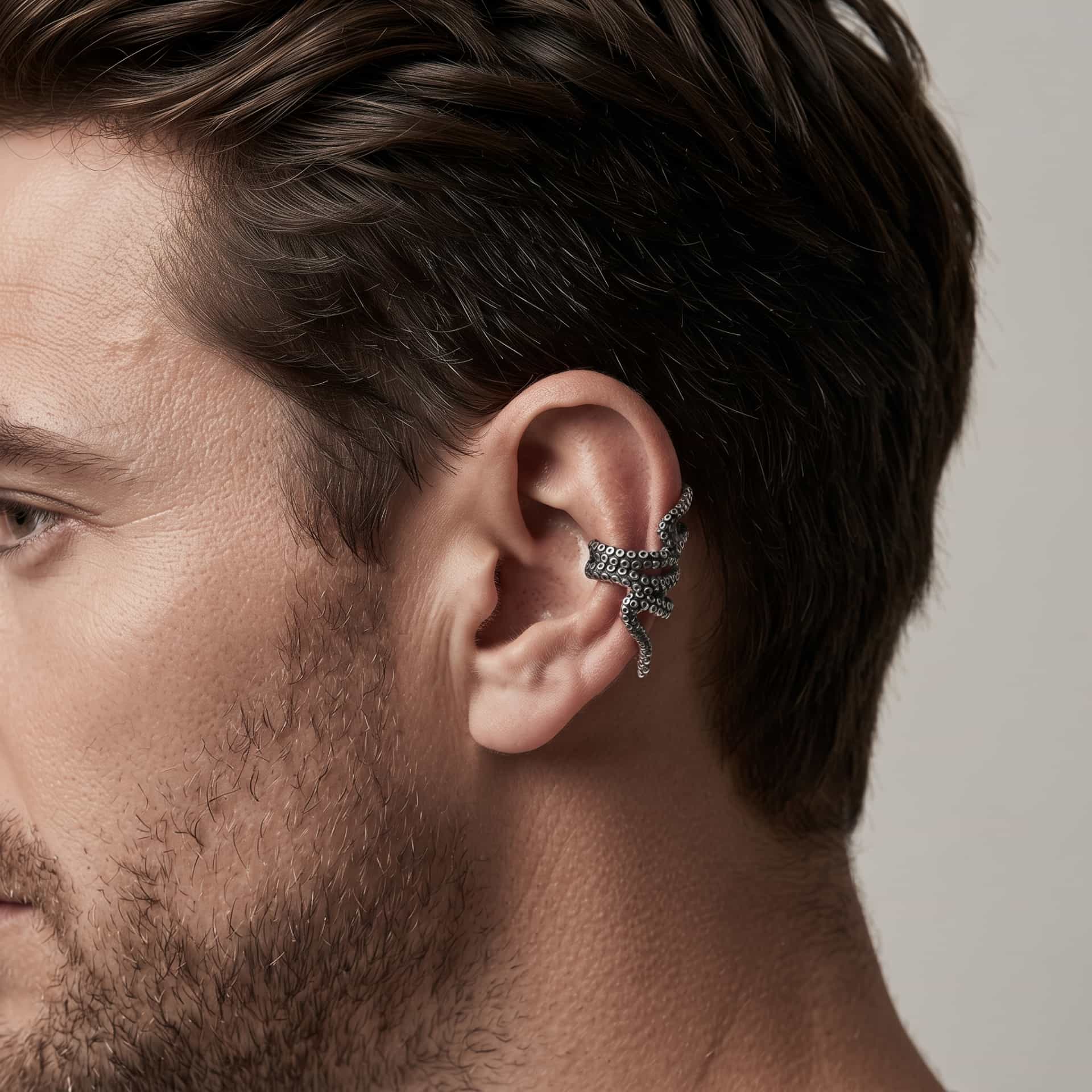
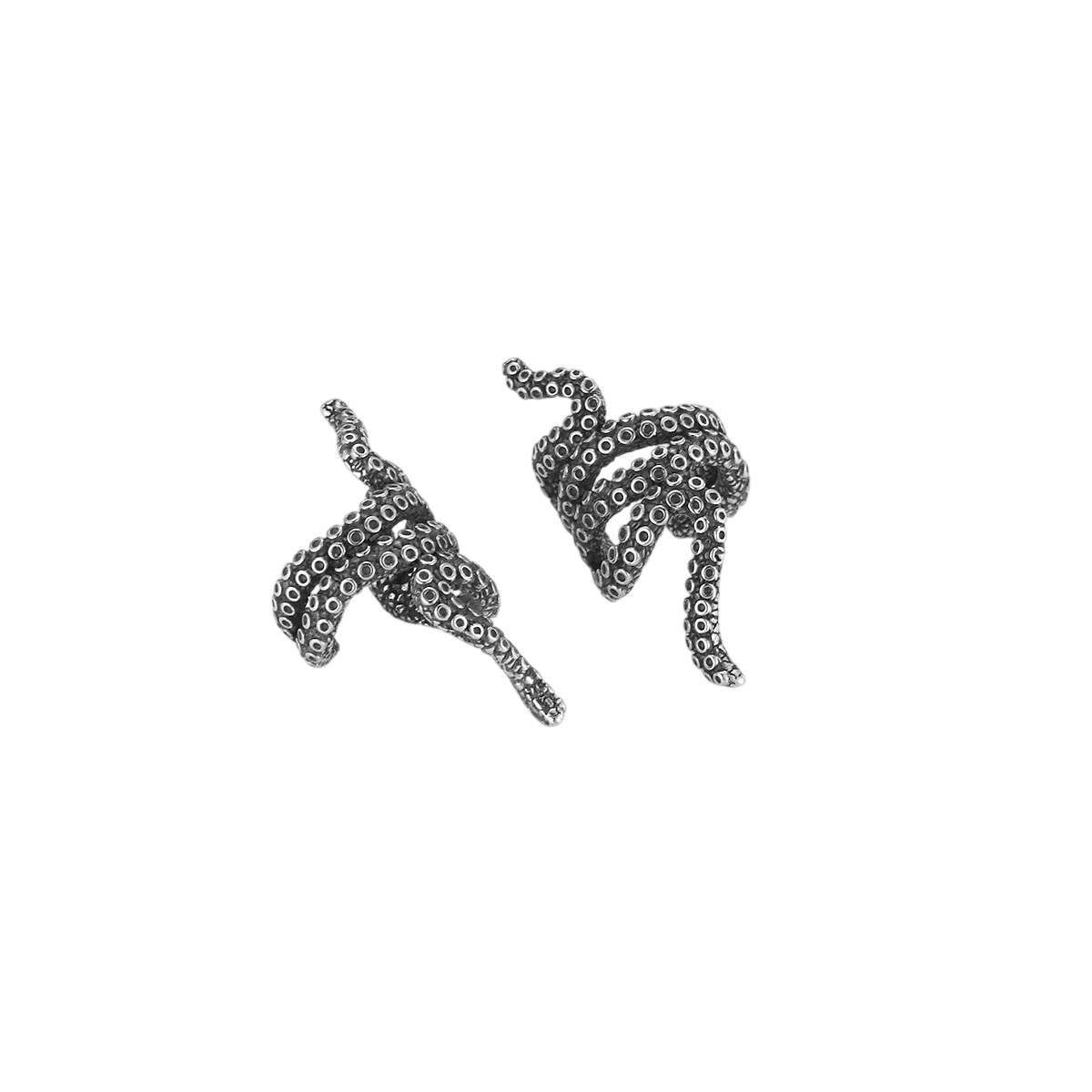
Tentacle Ear Cuff — Non-Pierced
Specifications
| Color | Black |
| Material | Stainless steel |
| For | Unisex |




- For: men & women (adults)
- Type: ear cuff
- Free shipping from 49€ · secure payment
A Tentacle Folded Over the Cartilage
This tentacle ear cuff bends the cephalopod's arm at a sharp angle: a thick base section, a tapered tip that curves, and suction cups hollowed out one by one along the entire inner side. The steel is patinated rather than polished, which accentuates the relief. Find this product in our Viking earring collection.
The same motif in a half-hoop can be found on our Kraken tentacle hoops, which wrap around instead of folding.
What Distinguishes This Piece
On a tentacle, it is the suction cups that do all the visual work.
- Hollowed suction cups: each disc is individually recessed, which creates a texture of shadows impossible to achieve by simple engraving.
- Angled fold: the break in the arm provides depth and causes the piece to stand slightly away from the ear, rather than lying flat against it.
- No piercing: the clip is adjusted with your fingertips and can be removed instantly.
- Patinated steel: the dark finish recesses the suction cups instead of drowning them in shine.
For the entire animal rather than an isolated limb, see our octopus clips.
Specifications
- Material: Stainless steel, patinated finish
- Shape: Ear cuff (open ring)
- Clasp: None, held by tension
- Sold: By the pair
- Piercing: Not required
- Care: Warm water, mild soap, dry with a soft cloth
Did you know?
If the Northern seas have a reputation for being teeming with monsters, it is largely the fault of one man. In 1539, the exiled Swedish archbishop Olaus Magnus published the Carta marina in Venice, a massive map of Scandinavia and its waters. It is remarkably documented for the coastlines—and copiously populated with creatures: sea serpents coiled around ships, fanged fish, and colossal beasts with raised fins. In his mind, these figures were not decorative: Olaus Magnus held them to be real animals, as described by sailors. The map was copied and recopied for two centuries, and it is through it that the monsters of the North entered the European imagination.
📖 To go further: Discover our guide to Nordic creatures, from ancient texts to later inventions.
♦ Complete Your Viking Collection
Discover other Viking accessories you might like:
Can the patina finish wear off?
No. The blackening is created on the metal itself, not with a varnish, so it does not flake. The most exposed edges may lighten very gradually through friction, which heightens the contrast.
Does the tentacle stick out much from the ear?
The bend makes it stand off by a few millimeters, just enough to cast a shadow and add depth. It does not snag, though.
Can I wear it on the earlobe?
Yes, on a thin earlobe. It is designed for the cartilage. On a thick earlobe, it will tend to loosen.
Does the Kraken appear in Viking sources?
No. The word first appears in 1753, in the writings of the Norwegian bishop Pontoppidan. The oldest giant sea creature of the North is the hafgufa of the King's Mirror, around 1250 — two centuries after the Viking Age.
Delivery — Allow 7 to 15 business days for mainland France, 10 to 20 days for the European Union. Free delivery on orders over €49.
Delivery guarantee — If your parcel is not delivered within 60 business days, we will provide an immediate reshipment or a full refund.
14-day returns — You have 14 calendar days from receipt to request an exchange or refund. The item must be returned within this period, in its original packaging.
Legal guarantees — All our products are covered by the legal guarantee of conformity and the guarantee against hidden defects, in accordance with the Consumer Code and the Civil Code.


