
Filters
53 products
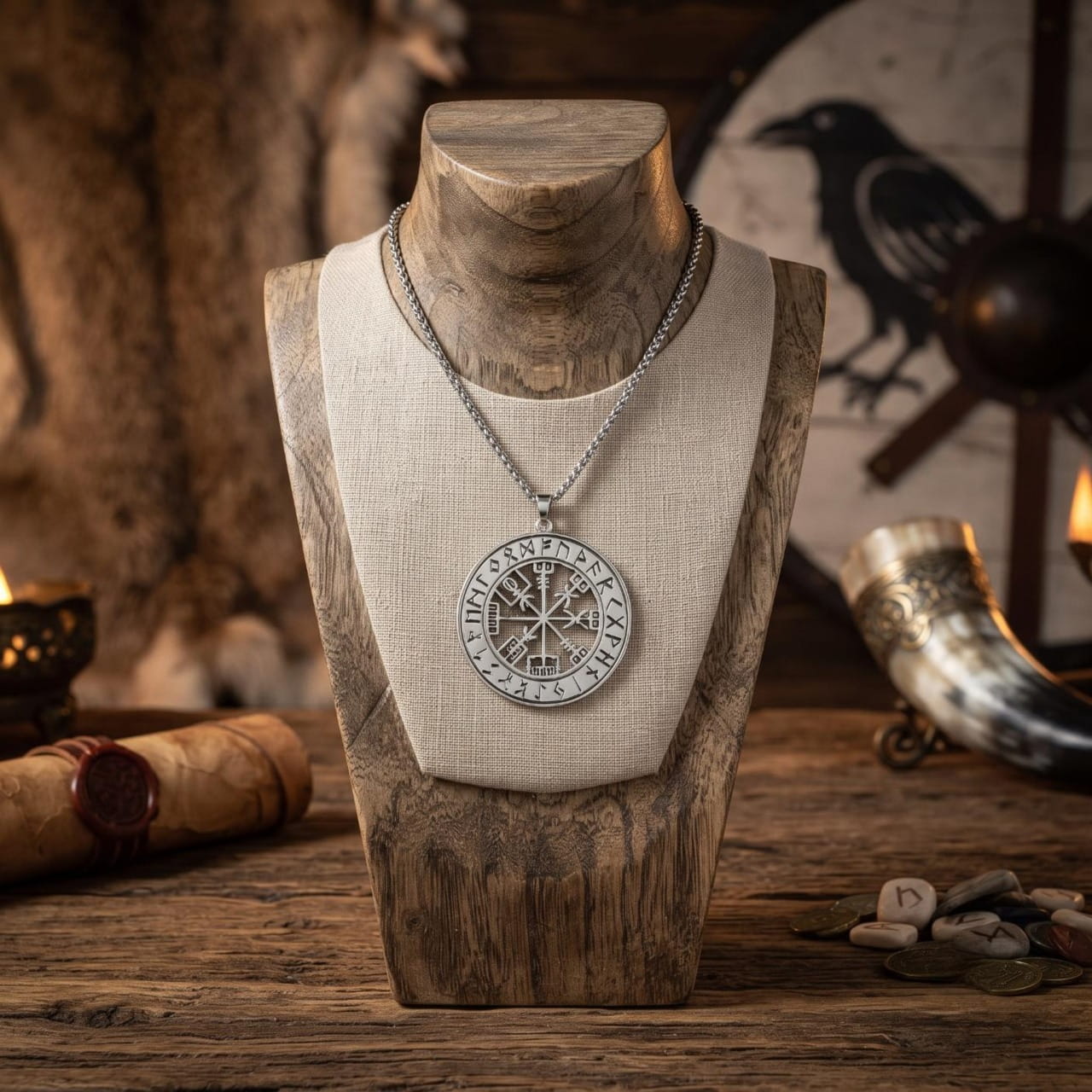
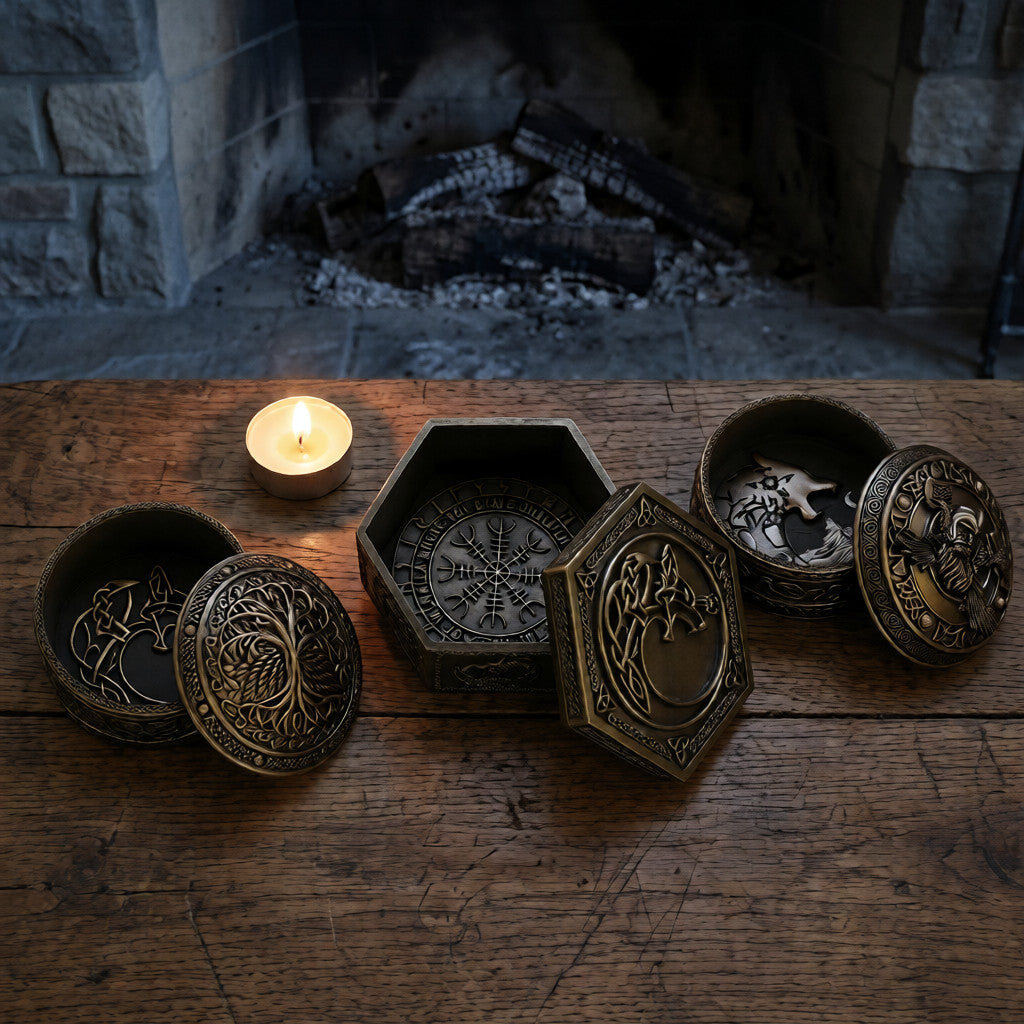
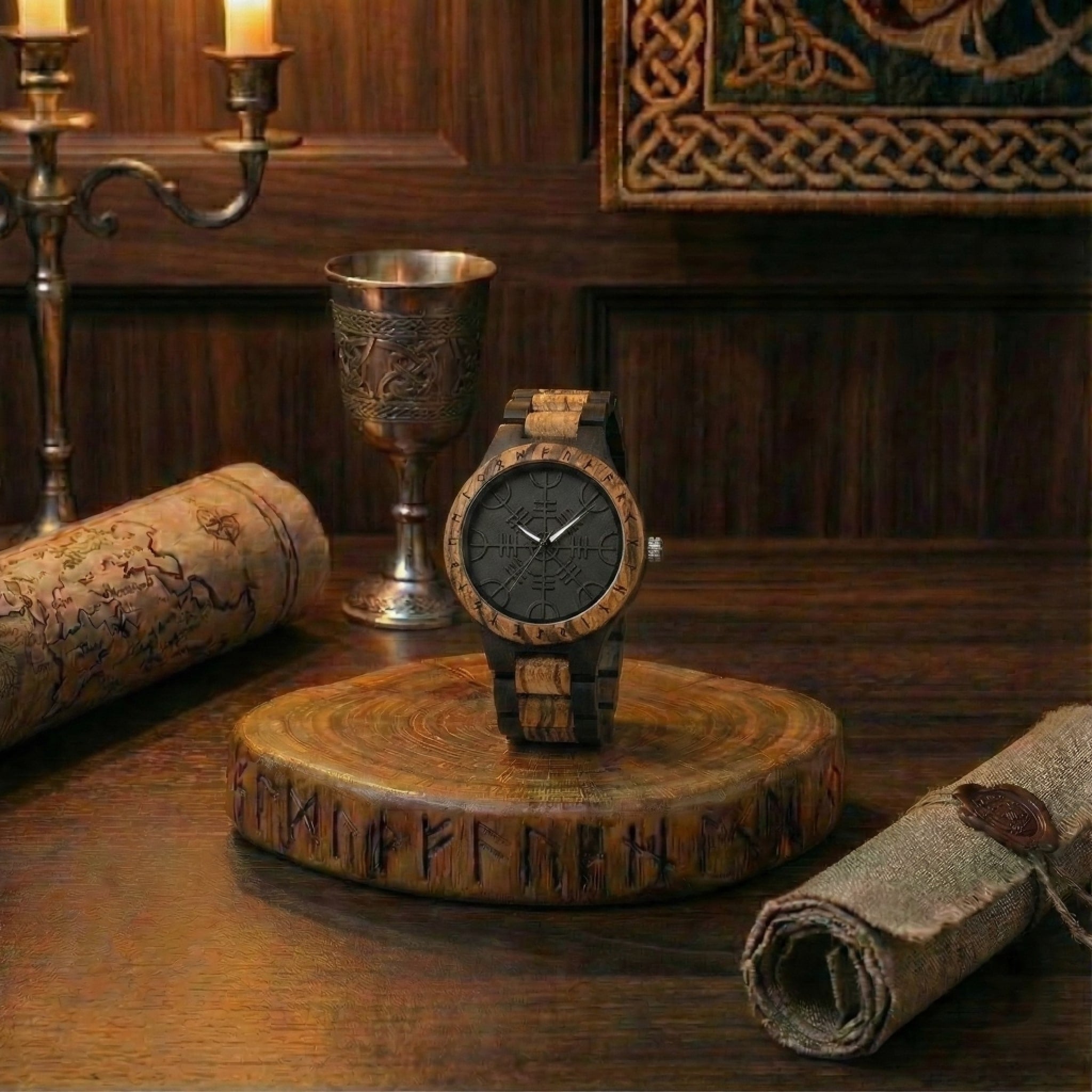
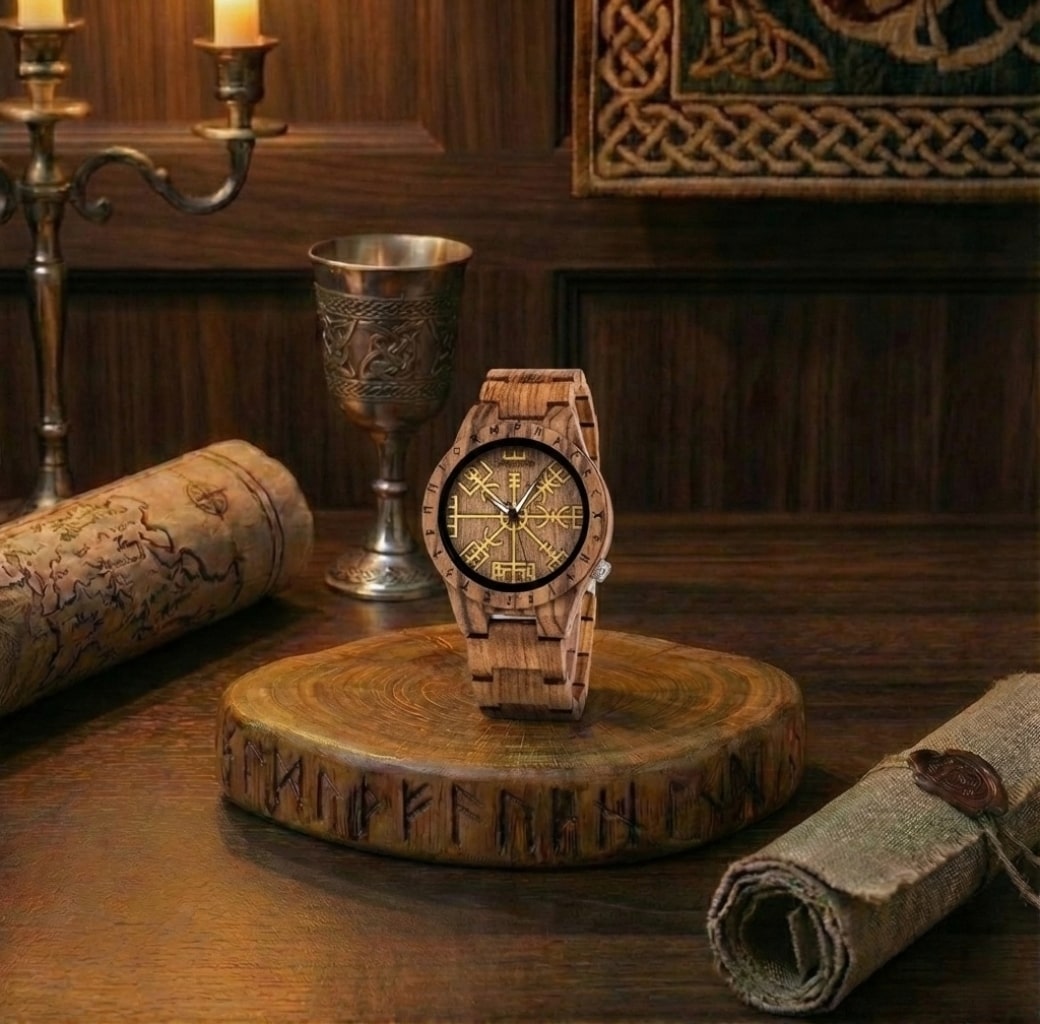
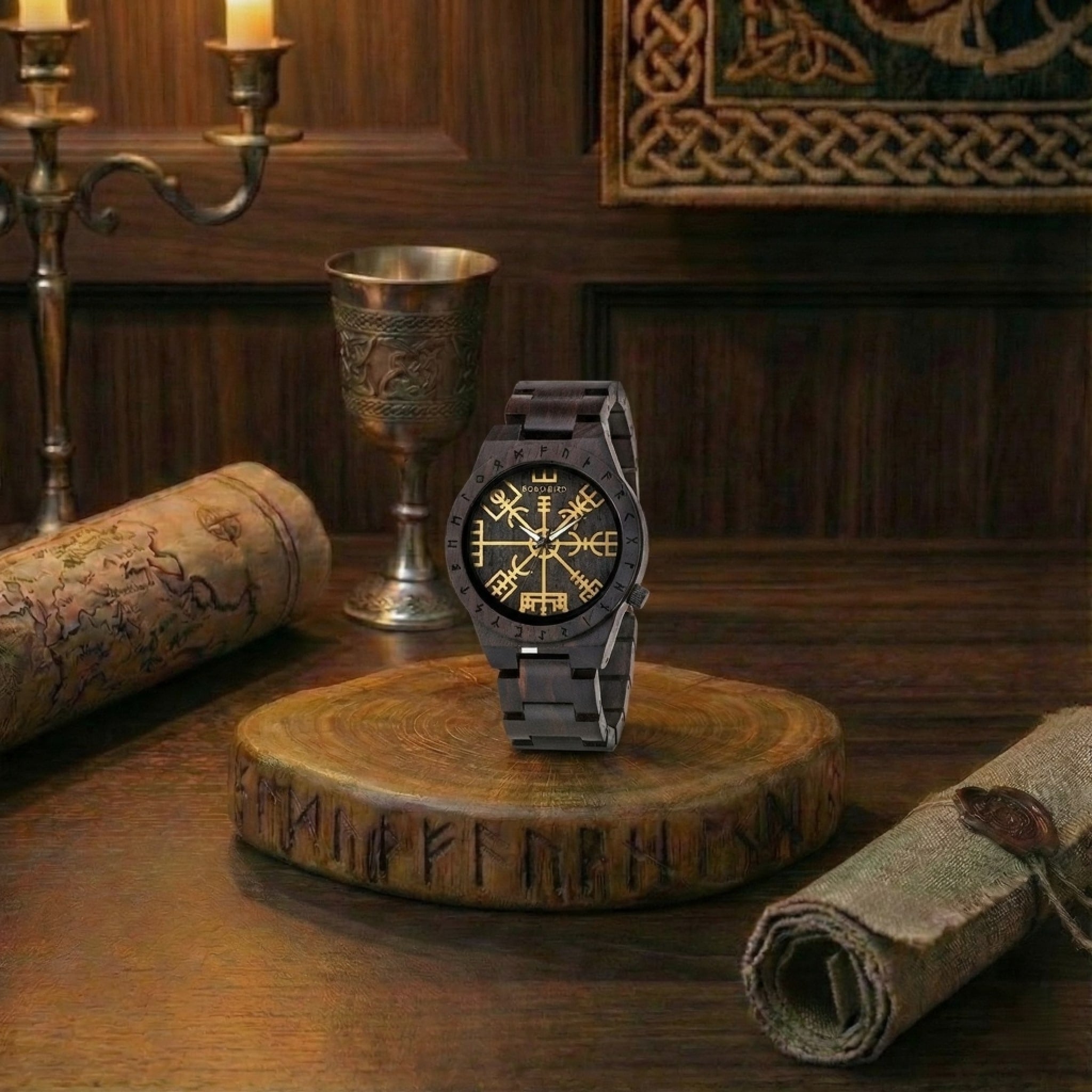
Vegvísir — The Runic Compass — en savoir plus
Eight runic branches radiating from a center: the Vegvísir has become, in just a few decades, one of the most worn Nordic symbols in the world. It is also the one surrounded by the most false claims. This page shares what we know about it, what it is not, and what we offer.
The Vegvísir at our shop, format by format
The Vegvísir is a circular design: it requires a round surface and space. It is therefore better suited for pendants and watch faces than for stud earrings.
| Format | For whom |
|---|---|
| Necklaces | The natural format for a round medallion |
| Watches | The symbol engraved on the dial |
| Bracelets | Bangle or chain with medallion |
| Rings | Signet ring with a round top |
| Earrings | Hoops with a medallion |
| Box and tapestry | Storage and wall display |
The necklace remains the reference format: it is the only one where the circle has enough diameter for the eight branches to be distinct. Our Viking necklaces offer several diameters.
An Icelandic grimoire from 1860
The Vegvísir appears for the first time in the Huld, a collection of magical signs compiled by hand in 1860 by Geir Vigfússon, in Akureyri, in northern Iceland. The manuscript is currently held at the National Library of Iceland under the reference ÍB 383 4to.
The note accompanying the drawing is short and matter-of-fact: whoever carries these signs with them will not get lost in storms or bad weather, even if they do not know the way. That is all. No mention of Odin, no sea navigation, no longships.
Eight centuries separate this notebook from the Viking Age. Two other 19th-century Icelandic manuscripts provide variants, all from the same era. No archaeological trace, no runestone, and no object from the Viking Age bears this motif.
The Vegvísir, in detail
What an Icelandic "magical stave" really is
The Vegvísir belongs to a well-identified family: the galdrastafir, or Icelandic magical staves. These are composite signs, drawn in handwritten grimoires between the 16th and 19th centuries, intended to achieve a specific effect—finding a thief, winning a lawsuit, curdling a cow's milk, or not getting lost.
This tradition blends an ancient Nordic foundation with European, Latin, and sometimes Kabbalistic magic, which arrived via books. It is truly Icelandic, but it is post-medieval and Christian. Confusing it with the religion of the Vikings is like confusing a Renaissance grimoire with a Gaulish ritual.
Do not confuse it with the Ægishjálmur
The second most famous sign in this tradition is the Ægishjálmur, the "Helm of Awe" or "Helm of Terror." It looks very similar: it also radiates from a center, and it also has eight branches. The difference is clear once you have seen it.
The eight branches of the Ægishjálmur are identical to one another, ending in symmetrical forks, and the pattern is purely geometric. Those of the Vegvísir are all different: each branch has a unique ending, such as crosses, hooks, circles, or bars. If all eight branches look the same, you have an Ægishjálmur.
What it is not
Three claims appear everywhere and are false. The Vegvísir is not a Viking compass: the Vikings did not have compasses; the magnetic needle did not reach Northern Europe until the 13th century. It was not painted on the sails of longships: no source says this; the image comes from a television series. And it does not have eight branches for the eight cardinal directions: nothing in the manuscript claims this; it is a modern reconstruction.
How the Vikings actually navigated
The question deserves more than a sign invented in the 19th century, because the real answer is more impressive. Nordic navigators practiced latitude sailing: they would travel along the coast until they reached the desired latitude, observe the position of the sun at noon, and then sail due west or east while maintaining that position.
They also read the sea: the color of the water, the direction of the swells, the presence of driftwood, the flight of birds, the passage of whales. The Landnámabók recounts that Flóki Vilgerðarson took three consecrated ravens to find Iceland—the third, released in the open sea, flew straight ahead without returning, and the ship only had to follow.
Finally, the sagas mention the sólarsteinn, or sunstone, which supposedly allowed for locating the sun in overcast weather. An Icelandic spar crystal found in a 1592 wreck off the coast of Alderney showed that the process works: the mineral doubles the image depending on the polarization of light and reveals the position of the sun behind the clouds. Proof for the Viking Age is still missing, but the hypothesis stands up.
The other staves of the grimoire
The Vegvísir is not alone. Icelandic grimoires list dozens of them, each with its own function, and the list is worth exploring because it sheds light on the spirit of these notebooks—very practical, very down-to-earth, quite far from the grandiose magic one might imagine.
The Þjófastafur is used to unmask a thief. The Veiðistafur is for catching fish. The Draumstafir is for dreaming of what you desire. Others promise to win a lawsuit, calm anger, or curdle a neighbor's cow's milk. One also finds signs of protection against the sea, ghosts, or livestock disease.
These staves were drawn on wood, leather, or parchment, sometimes on skin with blood or saliva, according to precise instructions detailed in the manuscripts. It is a magic of Icelandic peasants and fishermen from the Little Ice Age, not a liturgy of warriors.
Recognizing a correct design
Count the branches: there must be exactly eight, spaced every 45 degrees. This is the most common error in modern reproductions, which often show six or ten. Then verify that the eight endings differ from one another—otherwise, it is an Ægishjálmur. Finally, the design in the manuscript does not have an outer circle: the ring often seen is a modern decorative addition, which is perfectly acceptable but is not in the source.
The materials of our shop
Our Vegvísir items are made of stainless steel, most often blackened. This choice is not an aesthetic accident: the design is composed of fine lines, and on uniformly polished metal, the eight branches get lost in the reflections. The blackening settles into the engraved grooves and leaves the edges bright, which makes the design readable in any light.
This is exactly the principle of niello used by Scandinavian goldsmiths, who poured an alloy of black sulfides into the hollows of silver before polishing the surface. The watches combine steel with wood, with the symbol laser-engraved on the dial.
Maintenance
The Vegvísir is the motif with the most hollows in our collection: that is where its maintenance is key. Lukewarm water, mild soap, a soft toothbrush used in the grooves following the branches, then drying with a cloth. A clogged motif loses its contrast before it loses its shine.
On blackened pieces, avoid polishing paste: it would lighten the grooves and erase precisely what makes the branches visible. Stainless steel is not damaged by water or perspiration; only chlorinated products should be avoided.
How to wear it
The Vegvísir requires diameter. As a pendant, do not go below 25 mm: any smaller, and the endings of the branches become illegible and the medallion reads as an indistinct engraved round. On a chain, aim for 55 cm so the medallion falls mid-chest, where its surface is best highlighted.
It is a dense motif: pair it with sober pieces. A twisted bracelet without engravings or a smooth ring accompany it better than a second symbol. Two runic motifs worn together compete for attention, and neither wins.
Giving a Vegvísir as a gift
It is a farewell gift, in the literal sense: the symbol says "do not get lost," which makes it a natural piece for a move, a long journey, an expatriation, or a career change. The message is readable without needing to be explained, which is not the case for all Nordic signs.
A word of advice, however: if you give it, mention where it comes from. Many people believe they are wearing an ancient Viking symbol and learn the truth later, sometimes unpleasantly. Knowing that it is an Icelandic sign from 1860 does not take anything away from its beauty—it just avoids having to backtrack. To compare with a symbol attested by archaeology, see the Mjölnir.
Frequently Asked Questions
Is the Vegvísir a Viking symbol?
No. Its first known trace is an Icelandic manuscript from 1860. It is a late Icelandic sign, stemming from the tradition of grimoires, not a motif from the Viking Age. We prefer to write this rather than let people believe otherwise.
Does that take value away from the jewelry?
It depends on what you are looking for. If you want an archaeological reproduction, yes, turn toward Thor's hammer or the Valknut. If you love the design and what it says, no: a symbol from 1860 is still a 165-year-old symbol, worn today by millions of people.
Why has it been seen everywhere for the past few years?
Its global spread owes a lot to Björk, who had the motif tattooed on her arm in 1982, well before tattoo studios made it a classic. Television series from the 2010s did the rest.
Polished or blackened?
Blackened, in nine cases out of ten. It is the only treatment that keeps the eight branches readable regardless of the light. Polished is more discreet and dressier, but the motif only appears at certain angles.
What medallion size to choose?
Twenty-five millimeters is a reasonable floor: below that, the eight endings visually merge and the medallion reads as a simple engraved circle. Between 25 and 30 mm, the motif is clear and the piece remains discreet under an open shirt. Beyond 35 mm, the pendant becomes a statement piece, worn on top of clothing rather than underneath.
Can it be worn with another symbol?
Technically yes, visually it is discouraged. The Vegvísir is the densest motif in the collection: eight branches, eight different endings, often with a circle of runes as a supplement. Placed next to a second busy sign, neither can be read. Pair it with smooth pieces.
📖 To go further: our file on magical runes and protection rituals, the 17 Viking symbols to situate the Vegvísir among the others, and our guide to reading runes.