
Filters
8 products
Cloaks & Hoods — en savoir plus
The cloak fastened on the right shoulder, and that detail says it all
It is the first reflex to develop when looking at an image of the Viking Age: look at the shoulder. The Scandinavian cloak — the skikkja, the feldr — was not a cape closed at the front, but a large rectangle of wool thrown over the back and pinned on the right shoulder with a fibula. The reason has nothing to do with looks: the right arm, the weapon arm, had to stay completely free. A man who wore his cloak fastened in the center was announcing that he had no intention of fighting.
That is why fibulae dominate Scandinavian men's grave goods: they were not jewelry, they were the buttons of the one garment that had none.
The vararfeldr: when a cloak served as currency
Medieval Iceland produced an object with no equivalent anywhere else: the vararfeldr, the “shaggy wool cloak.” Tufts of wool were knotted into the weave to imitate fur, shaggy on the outside, smooth on the inside. The result kept you warm in the rain and cost far less than a pelt.
The Grágás, the Icelandic law code, goes as far as to standardize its dimensions: a cloak that met the standard was worth a fixed value in ells of cloth, and therefore served as a means of payment on an island with no minted coinage. Fines, debts or a sea crossing were paid in cloaks. It is probably the only garment in European history to have been legal tender.
The trim: what set a free man apart from a chieftain
Everyone had wool. What made the difference was the border. The graves at Birka, in Sweden, have yielded tablet-woven bands — the brikkevev — brocaded with silk and silver threads and sewn along the edges of garments. The silk came from Byzantium or from the lands east of the Caspian, by way of the Volga route; the silver, from the Islamic world. A two-centimeter band thus told the story of a trade network spanning several thousand kilometers.
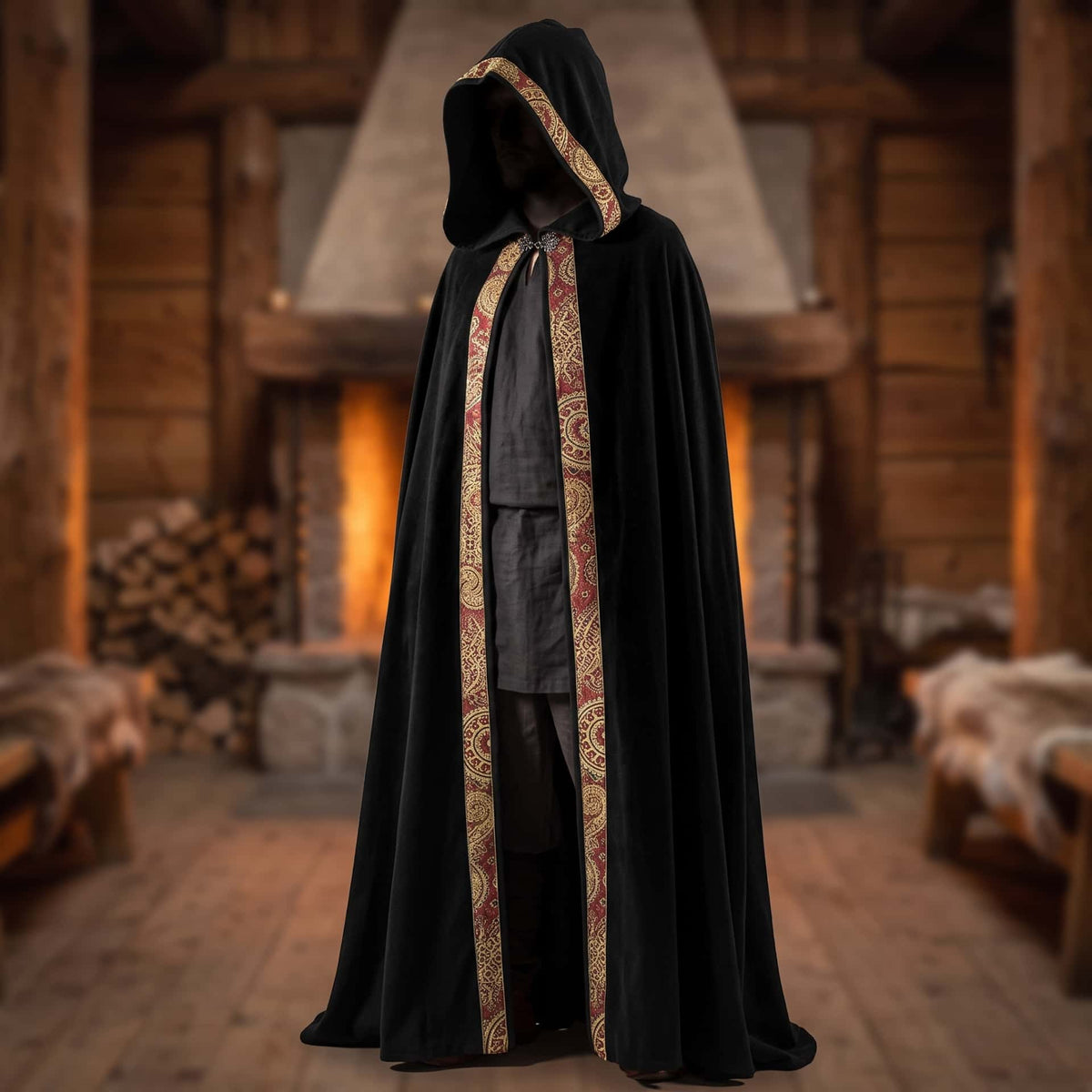
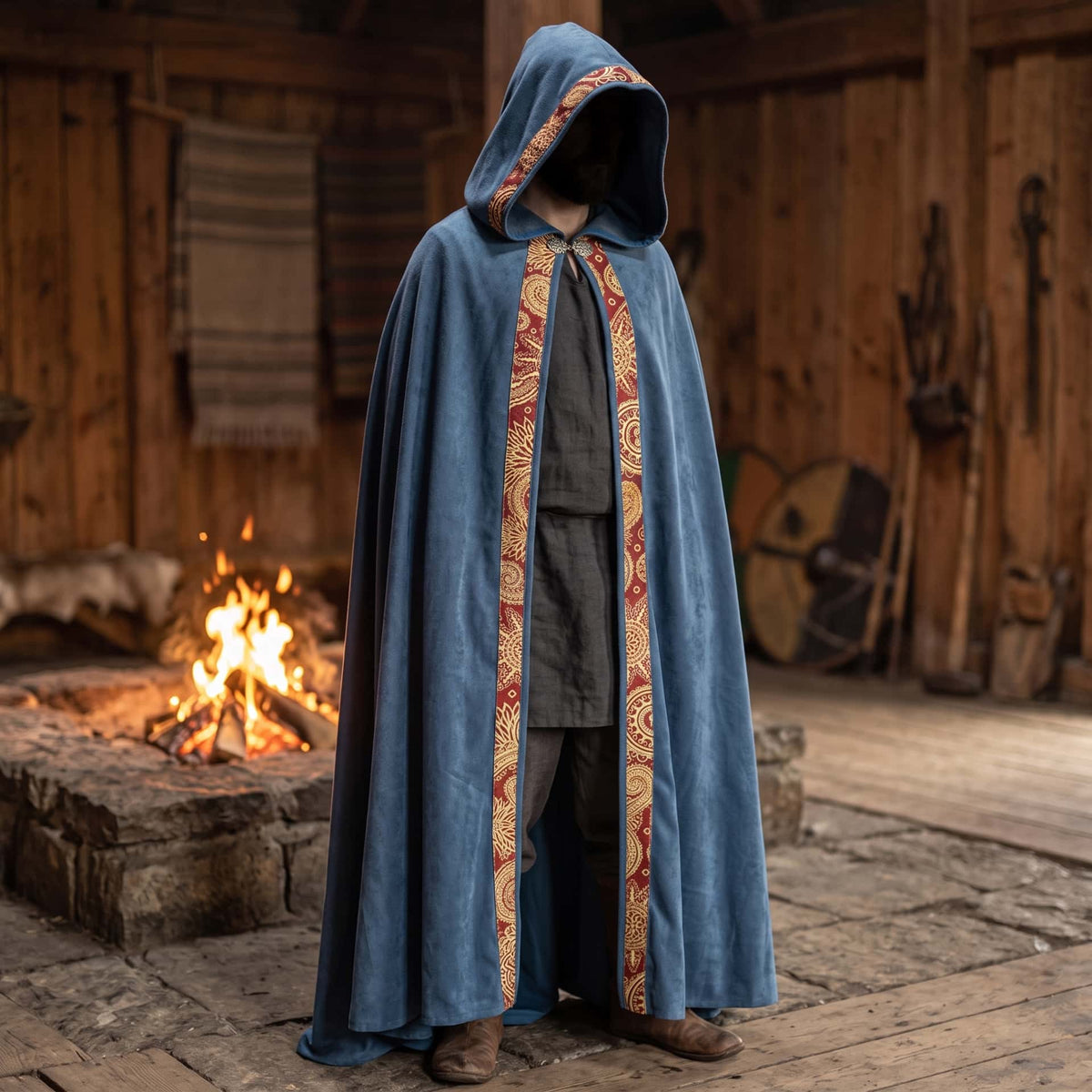
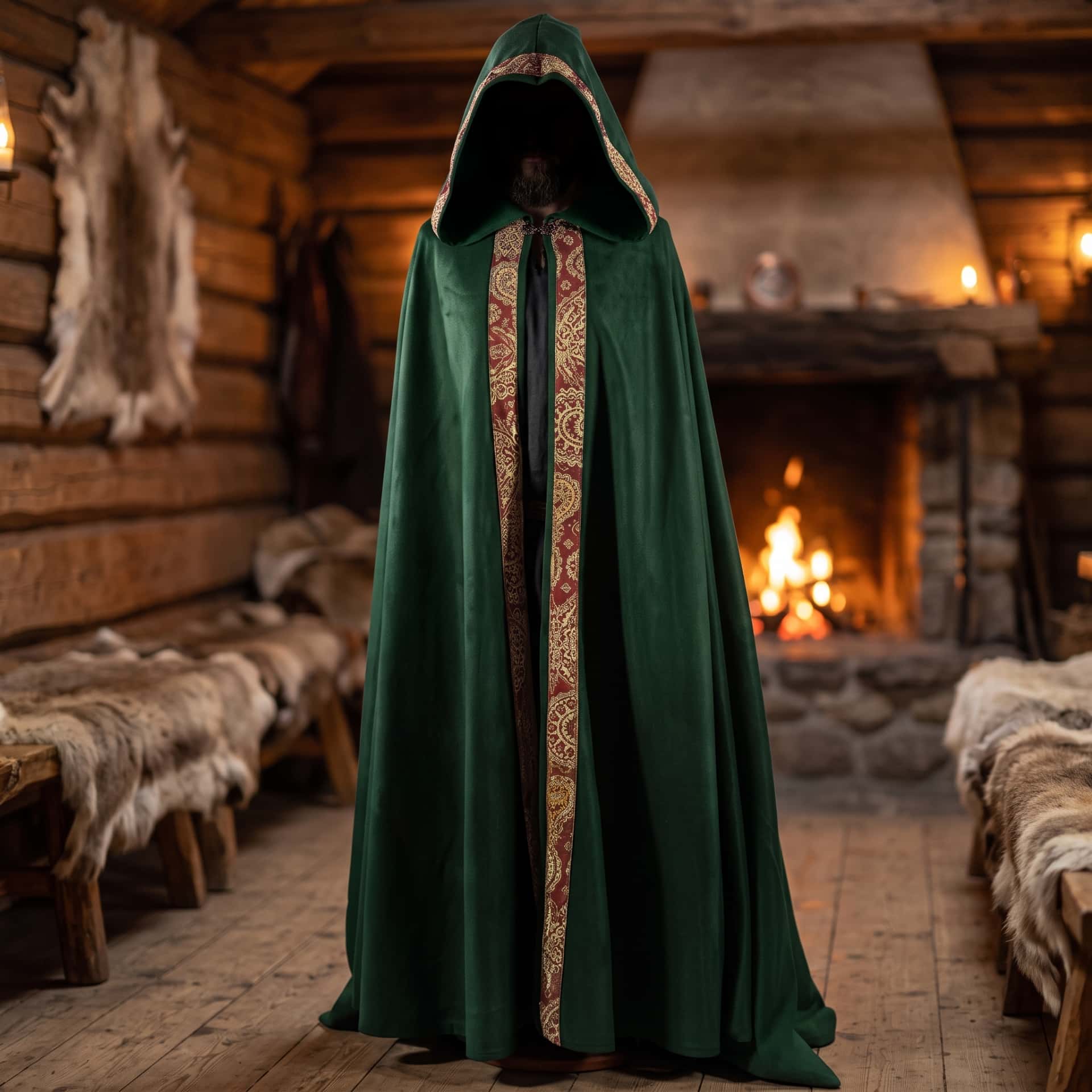
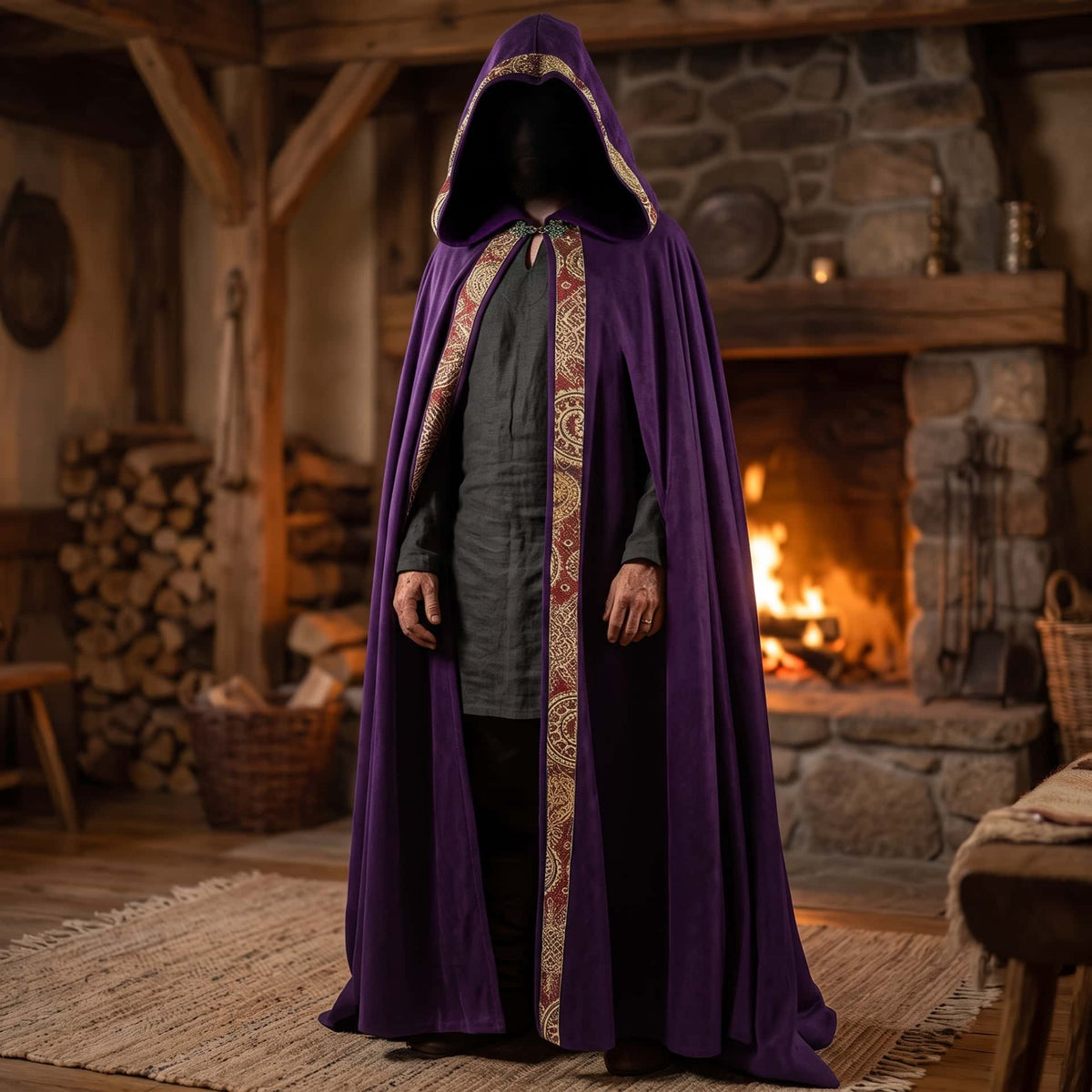
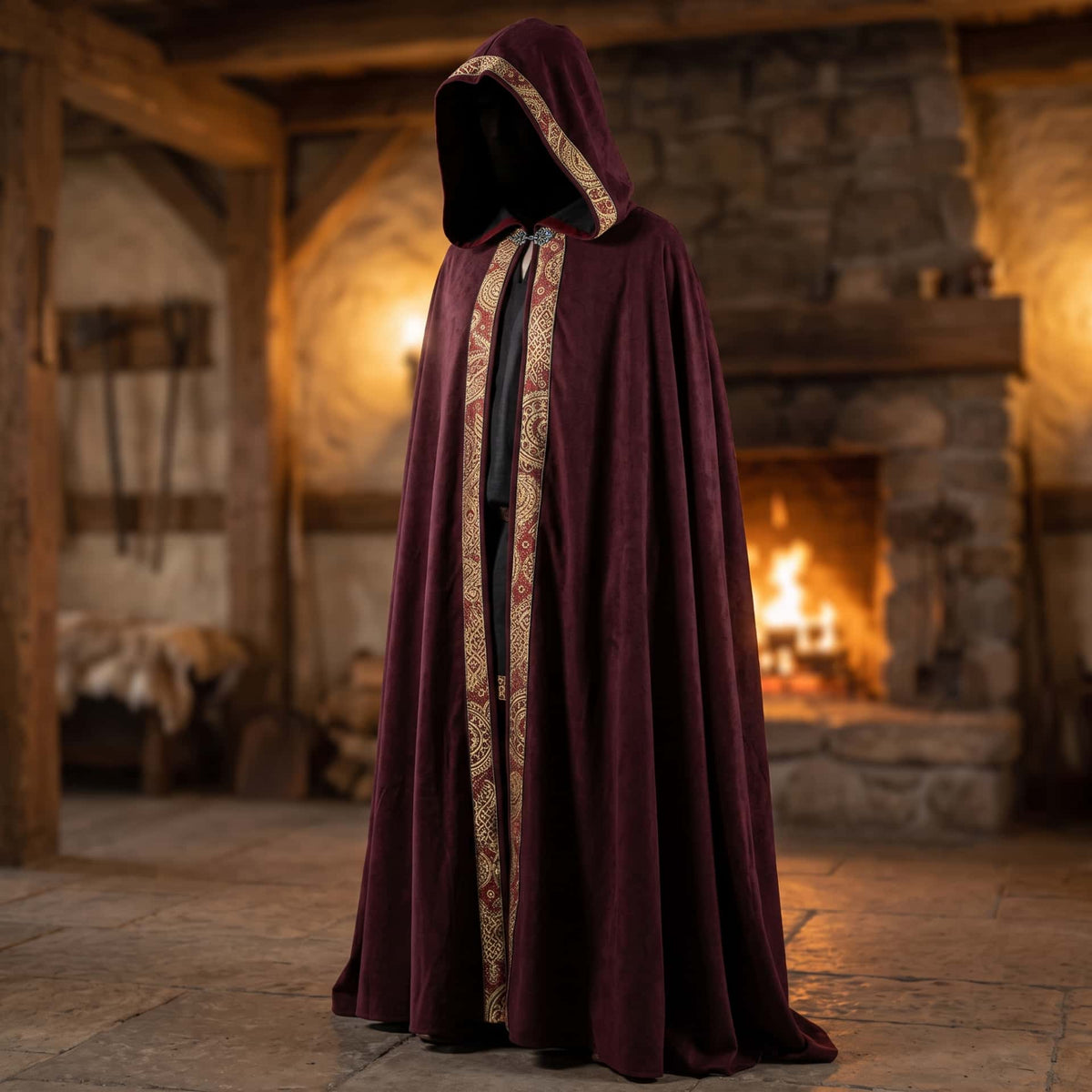
The cloaks in this section take up that principle: a decorated band runs along the opening, over its full length. It is the only element of their design that has a real archaeological ancestor.
The hood is not Viking, and that is perfectly fine
We may as well say it plainly: the cloak with a built-in hood is not a Viking Age form. The Scandinavian hood was a separate garment — the hetta — a piece pulled on over the head that covered the shoulders. The Skjoldehamn bog, in Norway, has preserved a complete example; the famous Bocksten Man, in Sweden, wore one with a long point, but three centuries later.
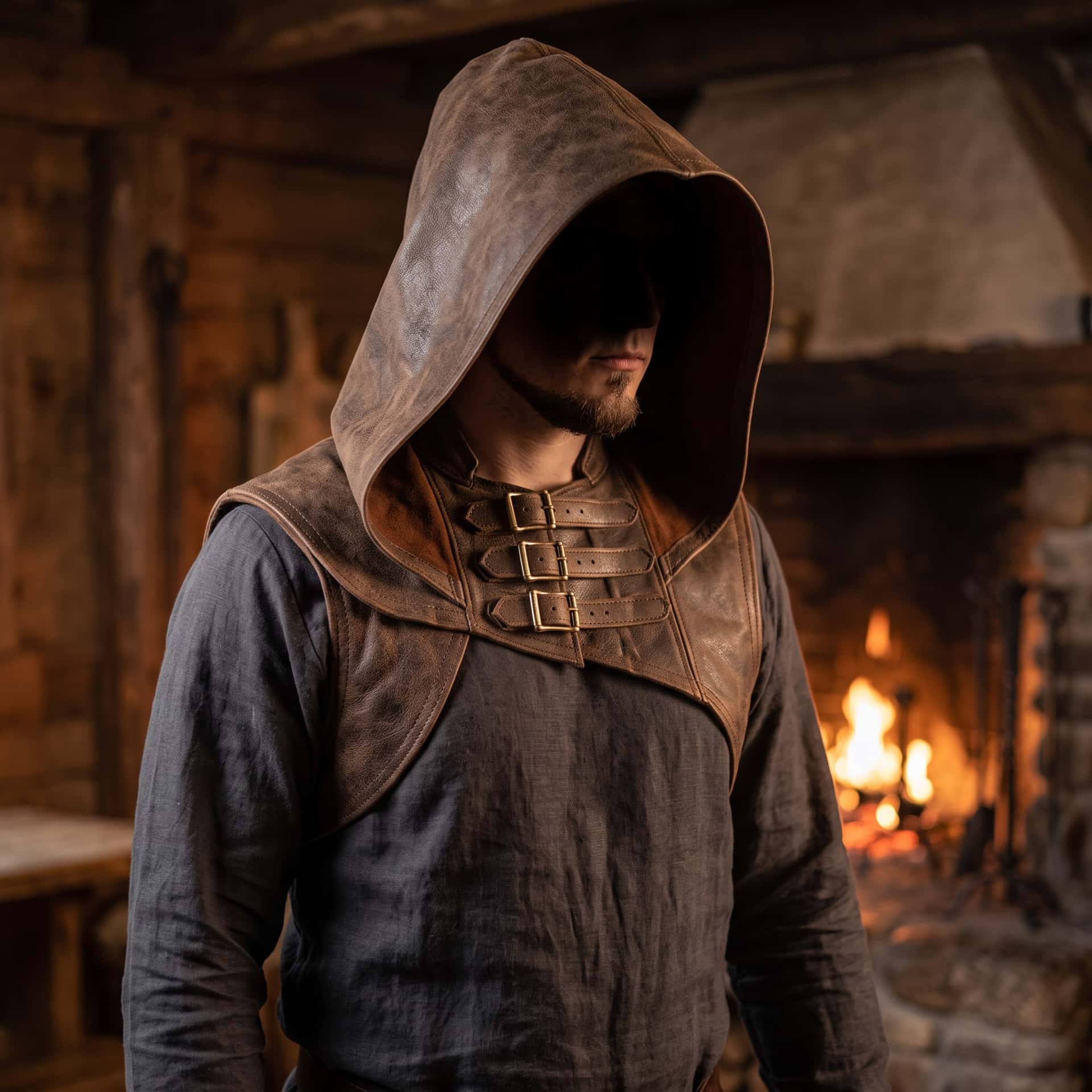
The hood with shoulder cape and buckles that you will find here descends from the medieval chaperon, not from a Norse pattern. It is worn on its own, over a tunic or a jacket, and it does exactly what is asked of it: cover the head and break up the silhouette.
Choosing yours
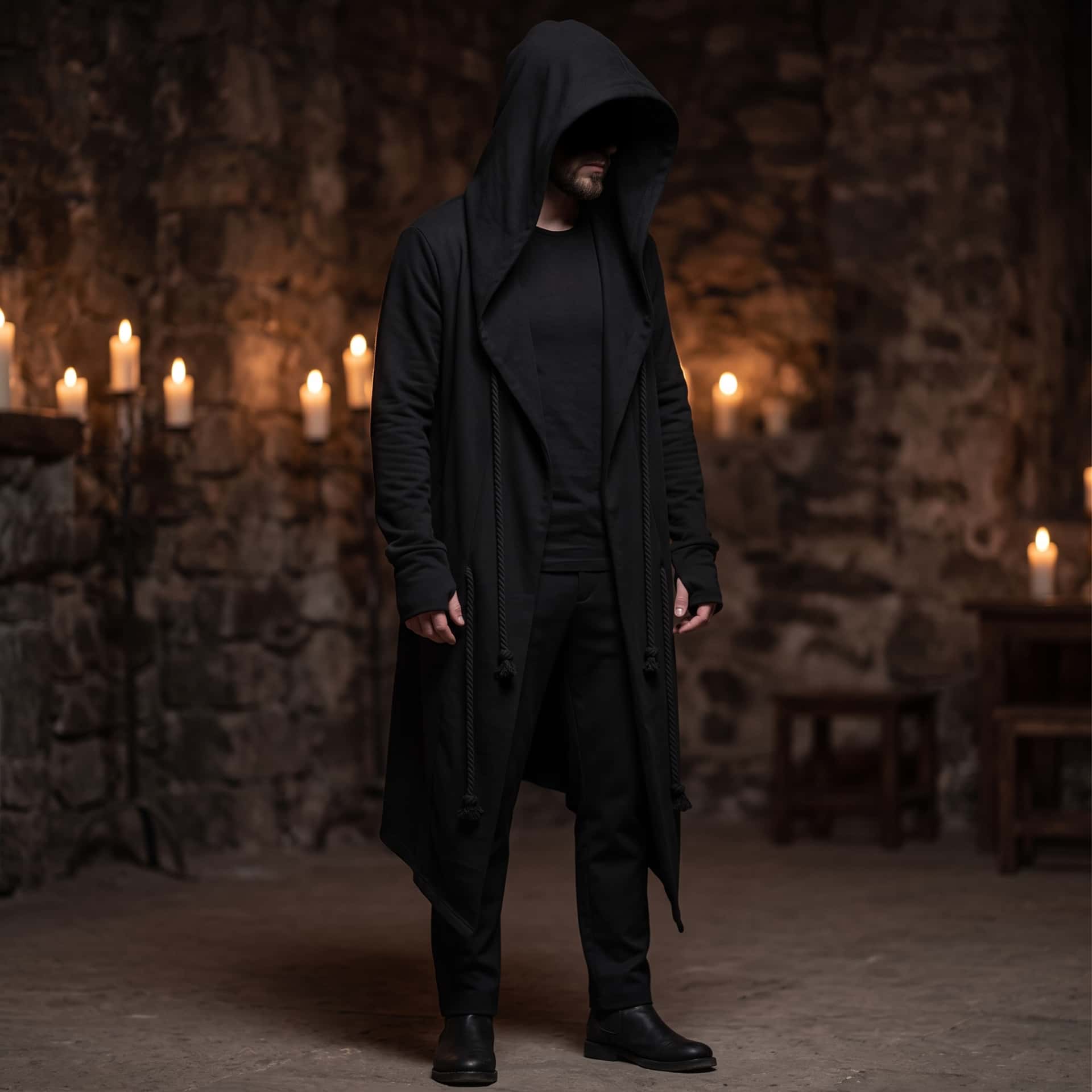
- The long hooded cloak falls to the floor and closes at the neck. It is the movie silhouette: the one that works in photos, at conventions and on stage. It needs room to sit down and a clean floor.
- The hood with shoulder cape covers only the head and upper back. It can be worn all evening without getting in the way, fits in a bag, and goes with any dark outfit.
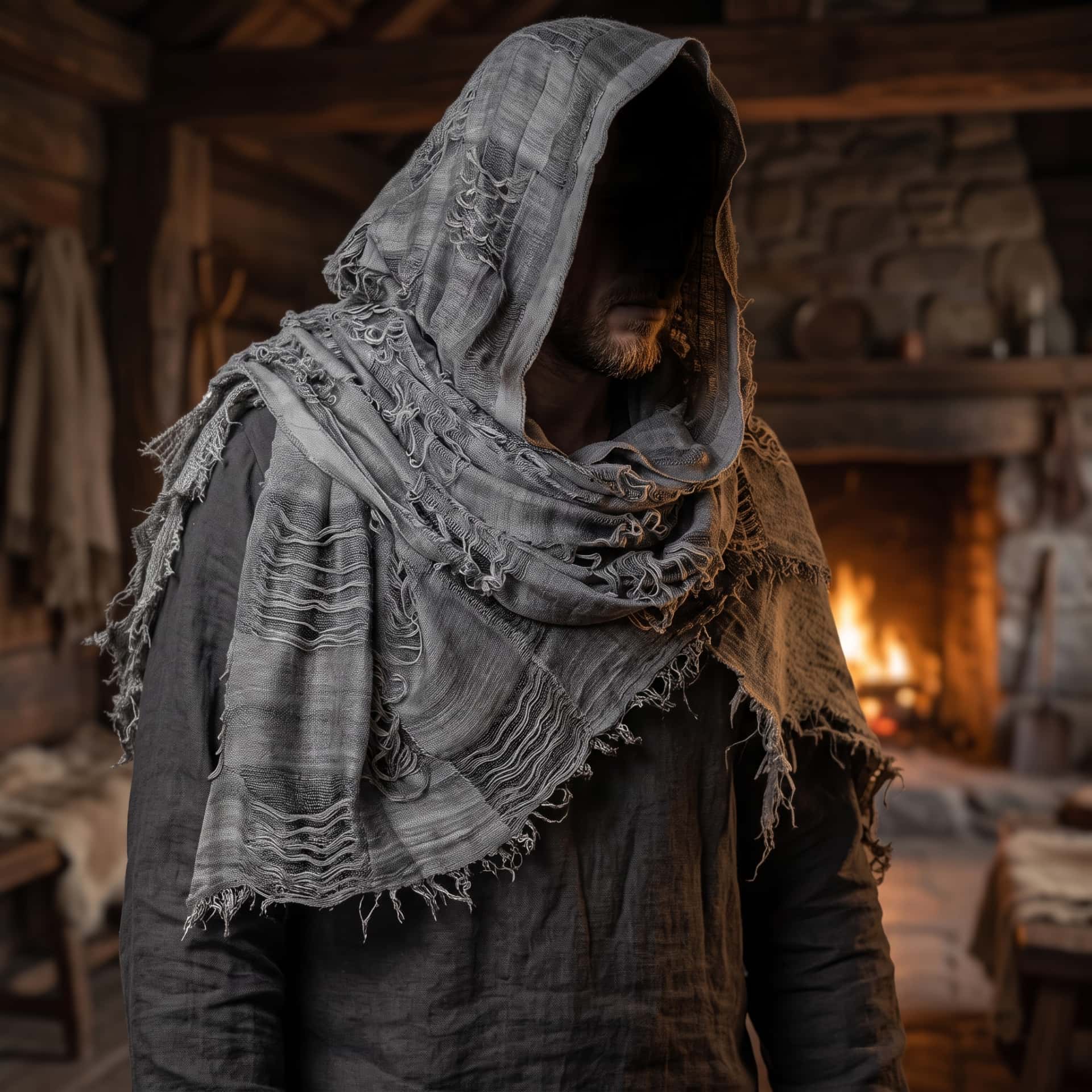
- The fringed stole wraps around the head and shoulders. It is the least constrained of the three: traveler, ranger, pilgrim — it commits to no particular era.
A word on color: the dyes available in the North gave madder red, woad blue and weld yellow. Deep green and purple existed but were expensive — purple above all, reserved for those who could afford it. If you are after historical credibility, burgundy and blue are your best allies; if you want to be seen, purple has been chosen for exactly that reason for two thousand years.
Frequently asked questions
Did the Vikings wear hooded cloaks?
No, not in this form. The cloak was a rectangle pinned on the right shoulder, and the hood a separate garment. The closed cloak with a built-in hood is a late medieval silhouette, popularized by the movies.
On which shoulder did the cloak fasten?
The right one, for men. That left the weapon arm free. The Scandinavian fibula is not a piece of jewelry: it is the fastener of that cloak.
What is a vararfeldr?
An Icelandic cloak with knotted tufts imitating fur. Its dimensions were set by law, and it served as a means of payment in an economy without minted coinage.
Can these cloaks be worn every day?
The hood with shoulder cape and the stole, yes, without any difficulty. The long cloak is a garment for the stage, conventions or photos: magnificent in motion, cumbersome in a hallway.
Did trim like this really exist?
Yes. Tablet-woven bands, sometimes brocaded with silk and silver, are among the best-documented textile finds from Birka. It is the most historically accurate detail of these pieces.