
Filters
51 products
Viking T-Shirts — en savoir plus
T-shirts with Norse designs — Odin's ravens, wolves, Yggdrasil, Mjölnir, longships, knotwork — in sizes XXS to 6XL, and a few kids' models from ages 4 to 14. In this section, what sets the models apart is first of all the printing technique — and with it, a fabric and a look. It's the first thing to understand before choosing.
Three ways to print
The T-shirts fall into three families, and knowing which one you're looking at avoids half the disappointments.
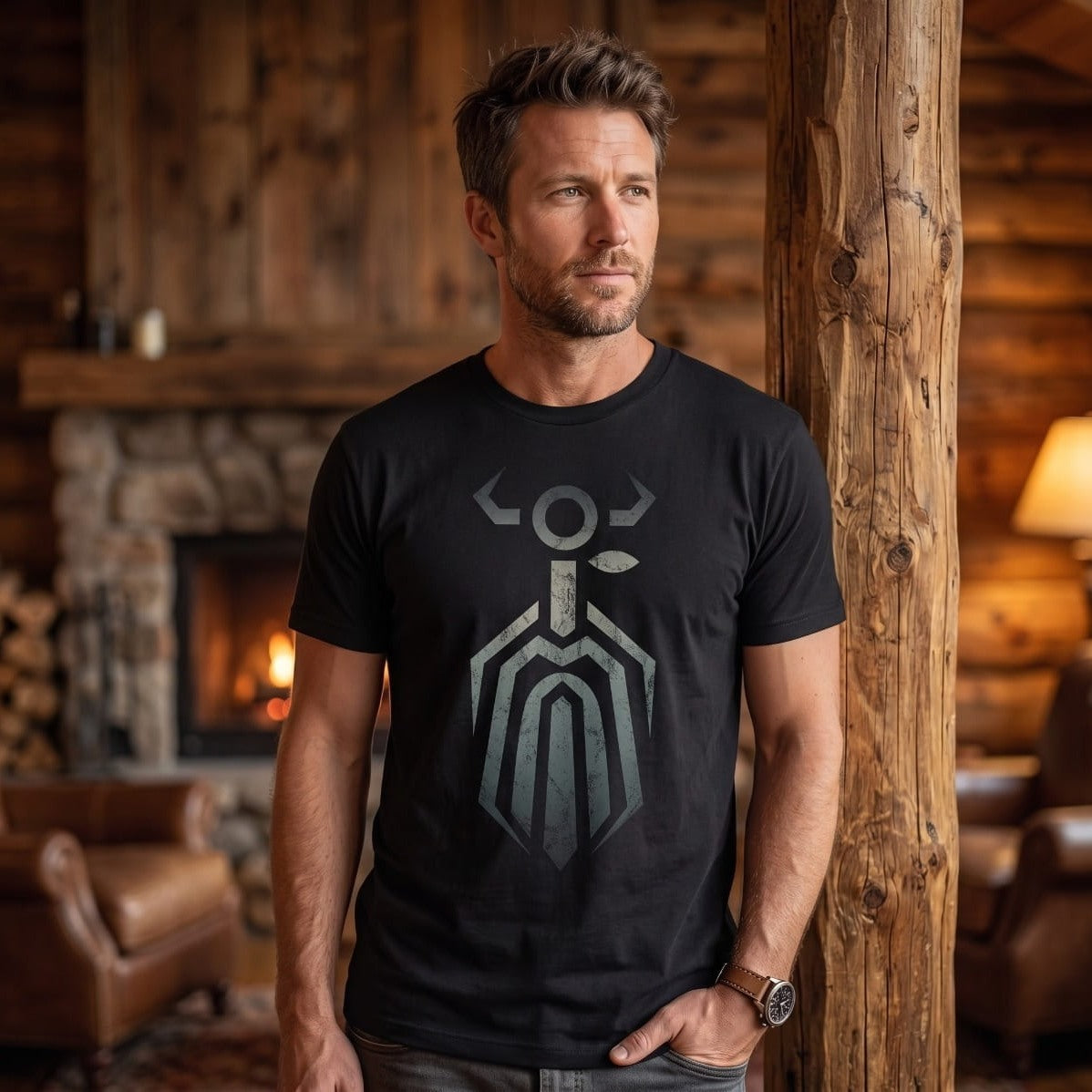
The discreet design on cotton. A small symbol, placed over the heart or between the shoulder blades: a stylized Odin, a Til Valhalla inscription, a map of the 793-1066 expeditions. This is the format you can wear under an open shirt or a jacket without the design taking over.
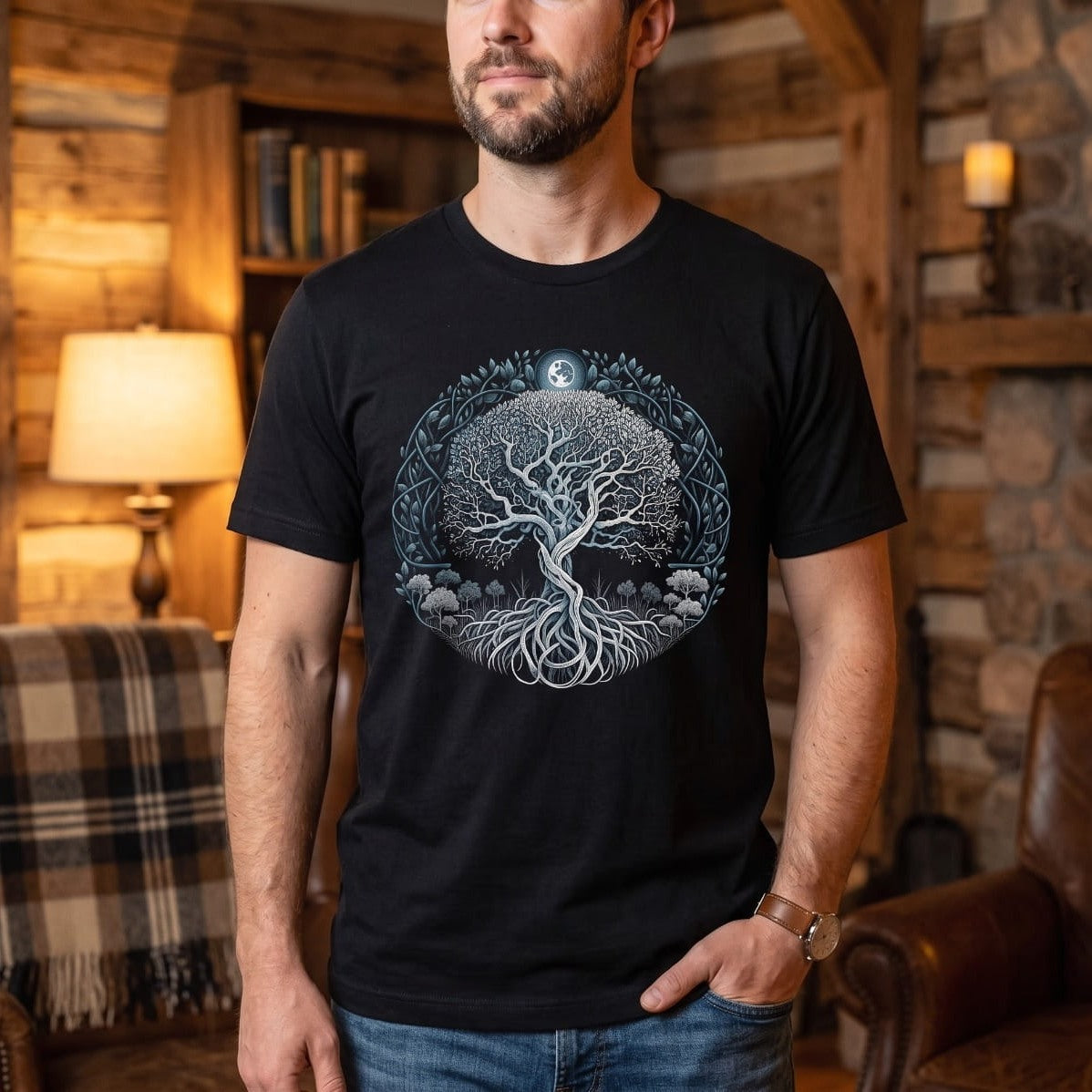
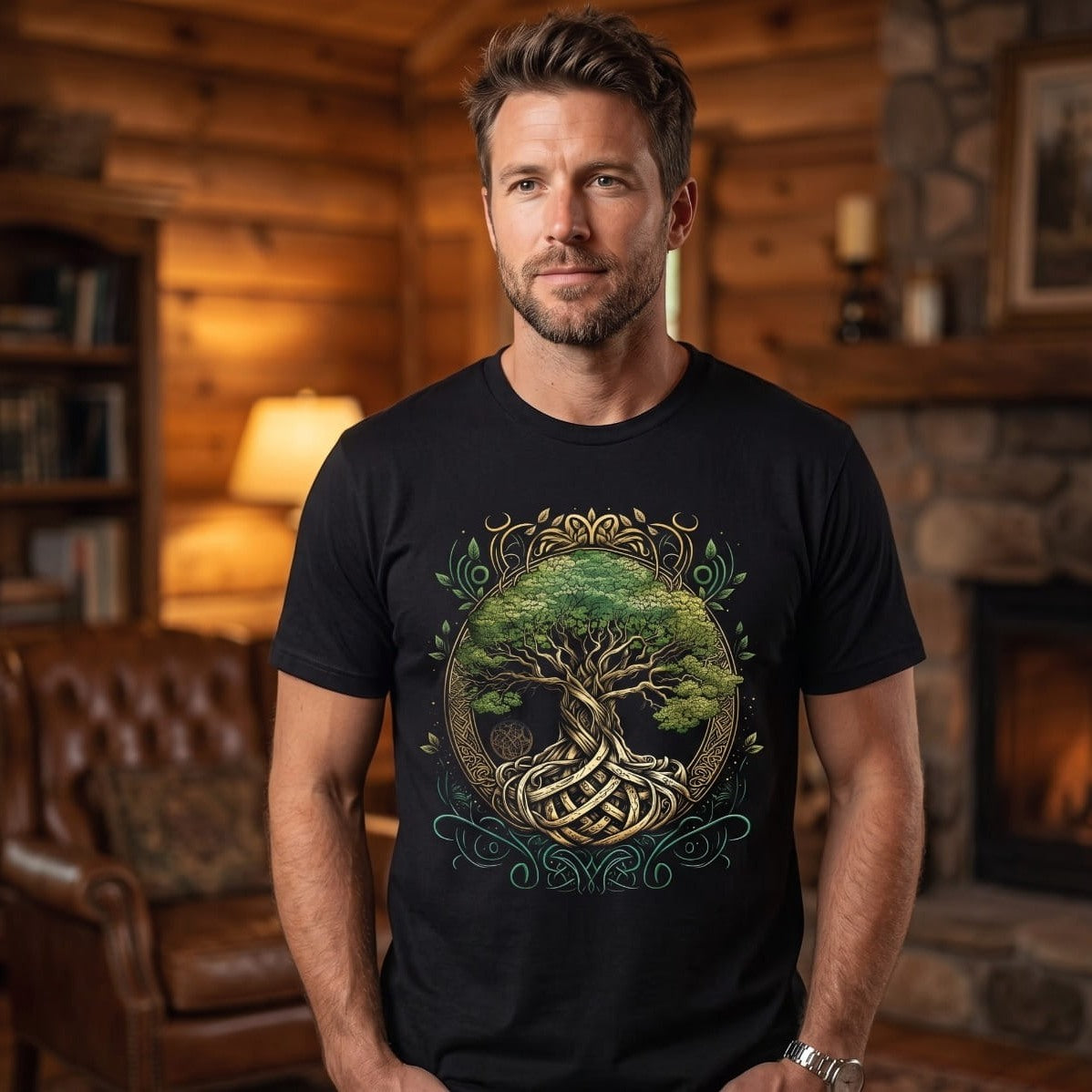
The chest design on cotton. The most common format in the section: a runic medallion, a raven with outspread wings, a silver Yggdrasil, printed large on the front — sometimes on the back. The garment remains a plain cotton T-shirt, usually black, white or navy blue, with a design that reads from a distance.
The all-over print on polyester. The design no longer stops at a frame: it covers the garment from seam to seam, sleeves and back included, with no visible edge or join. A howling wolf whose jaws climb up onto the shoulder, embers rising from the hem, a Mjölnir cutting across the chest. This is not the piece you put on to go unnoticed.
Why all-over prints are polyester
It's not a cost-cutting choice, it's a physical constraint — and it works in your favor.
All-over printing is done by sublimation: the ink is heated until it passes directly from a solid to a gaseous state, then penetrates the synthetic fiber and sets there as it cools. The ink becomes part of the fabric instead of sitting on top of it. The direct result: an all-over print does not crack, peel or flake in the wash, unlike a screen print applied to the surface, which always ends up cracking.
But sublimation only works on synthetic fiber. On cotton, the ink has nothing to bond to. That is the reason, and the only one, why all the all-over prints in this section are polyester. On the flip side, polyester breathes less well than cotton in hot weather and retains odors more — a compromise we own, not a hidden flaw.
The cotton T-shirts, for their part, carry a print applied to the surface. Softer to the touch and more breathable, but to be treated with a little more care in the wash.
Choosing your size
Just one method, but it never fails. Take a T-shirt you already wear and that fits you well. Lay it flat, measure the width from one armpit seam to the other, and multiply by two. That gives you the garment's chest measurement. Compare this figure with the one shown on the product page.
That way you're comparing a garment with a garment, without going through a theoretical size — and theoretical sizes are precisely what varies from one manufacturer to another.
The cut runs small: narrower in the shoulders and shorter in the body than a European cut in the same size. If you're between two sizes, take the larger one. On an all-over print, this advice counts double: the design is calibrated to the pattern, and a garment that's too tight stretches the artwork across the chest.
The measurements published on each product page are the manufacturer's, in centimeters, with the garment laid flat. When we don't have them, we say so rather than copying a generic chart.
The designs, family by family
The same figures come back from one model to the next. Here's what they really stand for — and, where relevant, what they're wrongly credited with.
Odin's ravens
This is the most common figure in the section. Huginn and Muninn — “thought” and “memory” — fly across the world every day and return in the evening to tell Odin what they have seen. Snorri Sturluson reports in the Gylfaginning that Odin fears for them: for Huginn above all, since a god deprived of thought would be lost. The raven is also the bird of the battlefield, which explains why it is found engraved on weapons as much as on jewelry. Our article on Huginn and Muninn goes through the sources, and the raven collection features the motif on jewelry.
The wolves
Be careful not to mix them up: Norse mythology has several, and they don't mean the same thing. Fenrir is the giant wolf, son of Loki, bound by the fetter Gleipnir, who will devour Odin at Ragnarök. Sköll and Hati chase the sun and the moon respectively, and will catch them on the day the world ends — they are the pair shown on the models with two wolves facing each other. Finally, Geri and Freki are Odin's two wolves, who eat at his table while he himself lives on wine alone. Our article on Fenrir tells the story of his binding in detail.
The Vegvísir
This eight-armed circle appears on several models, often paired with a wolf or a Mjölnir. Let's be clear: it is not Viking. It appears in only one document, the Huld manuscript, a collection of Icelandic sigils compiled by Geir Vigfússon in Akureyri in 1860 — eight centuries after the end of the Viking Age. It's a magnificent symbol that carries a real Icelandic magical tradition, but not an ancient Scandinavian one. The details are in our article on the Vegvísir.
The Valknut
Three interlocking triangles. The motif itself is well attested: it is found on the Stora Hammars stones on Gotland, on the Tängelgårda stone and on the bed from the Oseberg ship, often in scenes that evoke sacrifice or death in battle — hence its association with Odin and fallen warriors. Its name, however, is modern: “Valknut” is a 19th-century Norwegian invention, formed from valr (those slain in battle) and knut (knot). What the Scandinavians called it, we do not know. See our article on the Valknut.
Yggdrasil and Mjölnir
Yggdrasil, the ash tree whose roots reach down to three springs and whose branches spread across the sky, is described in the Völuspá and by Snorri. But no medieval depiction of it has come down to us: the symmetrical tree printed on our T-shirts is a modern creation, built from the texts. Mjölnir, by contrast, is the best-documented symbol of all — more than a thousand hammer pendants have been unearthed, from Denmark to Russia, and their proliferation in the 10th century is often read as a pagan response to the Christian cross.
Dragons, serpents and steeds
A few models move away from the major symbols toward narrative figures. Jörmungandr, the Midgard Serpent, so long that it encircles the earth and bites its own tail, which Thor fishes for in one of the most retold episodes of the Edda. Sleipnir, Odin's eight-legged horse, born of Loki transformed into a mare. The berserker's bear, echoing the berserkir of the sagas — literally “those in bear shirts” — whom the texts describe fighting in a fury that made them insensible to wounds. And the longships, called “drakkars” in French, a name that is itself a 19th-century neologism: the Scandinavians said langskip, the long ship.
Slogan models, and the rest
A handful of T-shirts play the humor or catchphrase card: See You In Valhalla, Until Valhalla, an axe-wielding warrior who doesn't take himself seriously, a cat in battle gear. They own their tone — these are witty T-shirts, not reenactment pieces.
Caring for a printed design
Wash at 30 °C maximum, inside out, without fabric softener — softener is what dulls prints fastest, by leaving a greasy film on the ink. Air dry, never in the dryer, whose heat cracks surface inks. Iron inside out only, and never directly on the design.
All-over prints stand up to repeated washing much better, since the ink is set inside the fiber. Prints on cotton call for the full routine. Either way, turning the T-shirt inside out before putting it in the machine takes care of most of it: it's friction against the drum that wears a design down, not water.
Frequently asked questions
What size Viking T-shirt should I choose? Measure a T-shirt you already wear, laid flat: the width from armpit to armpit multiplied by two, to compare with the chest measurement on the product page. Since the cut runs small, size up if in doubt.
What's the difference between a cotton T-shirt and an all-over print? The printing technique. On cotton, a design printed onto the T-shirt. With an all-over print, a sublimation print on polyester that covers the whole garment, sleeves and back included.
Are the T-shirts cotton? Part of the section, yes. The models with a single placed design are cotton, the all-over prints polyester — sublimation doesn't bond to a natural fiber. The material is listed on each product page.
Does the print hold up in the wash? Yes, at 30 °C, inside out and without fabric softener. All-over prints are the most durable, since the ink is set inside the fiber. The dryer and an iron placed directly on the design are the two real enemies.
Do you carry big sizes? Yes, up to 6XL on most models. The sizes actually available are listed in the drop-down menu on each product page.
Are there kids' sizes? On some models, from age 4 (100 cm) to age 14 (160 cm). They appear in the same menu as the adult sizes.
What T-shirt colors are available? The cotton models come mainly in black, white and navy blue. The all-over prints have no background color in the usual sense: the design is the color, and each item has its own palette.
What are the delivery times? Allow 10 to 20 working days in total: 3 to 5 days of processing, then 7 to 15 days of delivery to mainland France, 10 to 20 days within the European Union. Free tracked shipping from 49 €, whatever the destination country.
Explore further: for winter, see our Viking sweatshirts; for training, our tank tops; to complete the outfit, our caps and bandanas, our Viking necklaces and our Viking bracelets. The whole clothing section brings the four families together. For reading, our guide to the 17 Viking symbols covers each motif with its sources, and the Futhark runic alphabet explains the inscriptions.